

A 1.5-fold surge over three years, drone-enabled border smuggling, and a 553-km frontier with Pakistan have propelled Punjab to the top of the nation’s narcotics crisis — far outpacing every other state.
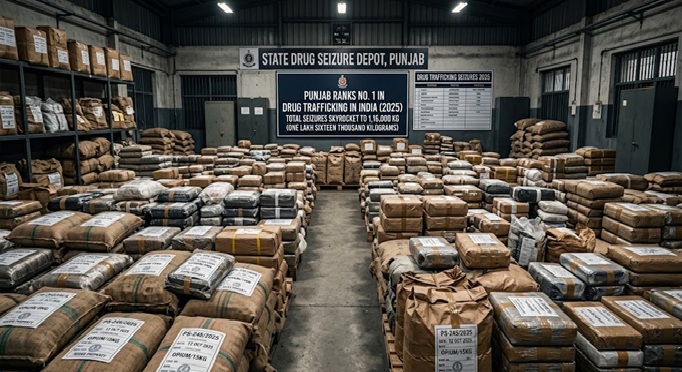
Punjab has earned the grim distinction of ranking first in the country for drug trafficking cases, according to a report released by the Union Ministry of Home Affairs. The state’s seizure figures have surged 1.5-fold over the past three years, culminating in a record 1,16,000 kilograms of narcotics recovered in 2025 alone — the highest total ever documented in a single year.
The scale of the crisis, laid bare in data compiled jointly by the Ministry of Home Affairs and the Narcotics Control Bureau (NCB), has alarmed security officials and policy makers alike. Villages strung along Punjab’s 553-kilometre international border with Pakistan have emerged as the primary conduit for traffickers, with a particularly alarming rise in drone-assisted deliveries that evade traditional surveillance.
#1 — Punjab’s national rank in drug trafficking cases 1,16,000 — Kilograms seized in 2025 — an all-time record 553 km — Punjab’s international border with Pakistan
The jump is staggering when set against recent history. Seizures stood at 47,475 kg in 2023 and dipped slightly to 46,227 kg in 2024 — figures that were themselves deeply troubling. The 2025 figure of 1,16,000 kg represents a near-tripling in a single year, a trajectory that security agencies describe as unprecedented.
Punjab Drug Seizures — Year on Year
- 2023: 47,475 kg
- 2024: 46,227 kg
- 2025: 1,16,000 kg ▲ Record
Source: Union Ministry of Home Affairs & Narcotics Control Bureau, 2026
“The 2025 seizure figure represents a near-tripling in a single year — a trajectory that security agencies describe as unprecedented.” — NCB Field Intelligence Unit, Punjab
Border Districts Bear the Brunt
The crisis is geographically concentrated. Six districts lying directly along Punjab’s international frontier — Amritsar, Tarn Taran, Gurdaspur, Pathankot, Ferozepur, and Fazilka — have become the dominant entry points for contraband. Of these, Tarn Taran has attracted particular scrutiny from the NCB, which has recorded a persistent and escalating pattern of drone-enabled drops targeting villages on the Indian side of the border.
Hotspot Districts:
- Amritsar — Primary entry corridor
- Tarn Taran — Drone activity hotspot
- Gurdaspur — Border zone
- Pathankot — Northern frontier
- Ferozepur — Southern corridor
- Fazilka — River boundary zone
Punjab Leads a Nation-Wide Problem
The crisis is not unique to Punjab — drug trafficking has surged across multiple states — but the scale of Punjab’s numbers sets it apart from every other state on the map.
State Comparison — 2024 vs 2025:
| State | 2024 (kg) | 2025 (kg) | Change |
|---|---|---|---|
| Punjab | 46,227 | 1,16,000 | ▲ +151% |
| Gujarat | 20,971 | 22,758 | ▲ +8.5% |
| Jammu & Kashmir | 5,708 | 4,491 | ▼ −21% |
| Rajasthan | Higher volume, but declining case count | ▼ Cases ↓ |
In Gujarat, a 553-km coastline and busy ports have long made it a trafficking hotspot, but its numbers rose only modestly this year. Jammu & Kashmir, despite its own troubled border situation, actually saw a decline in seized quantities in 2025. Rajasthan registered higher volumes in some categories but a fall in the number of registered cases — a pattern officials believe may reflect enforcement gaps rather than a genuine reduction in activity.
Weapons and Counterfeit Currency Travel the Same Routes
The narcotics pipeline has become a broader contraband corridor. The NCB report documents a parallel surge in the movement of weapons, ammunition, and counterfeit Indian currency across the same Punjab border routes used for drug drops. Recovered items have included AK-47 and AK-56 assault rifles, RDX explosive material, and foreign-manufactured weapons — a combination that has elevated the threat assessment from a public health emergency to a direct national security concern.
⚠ Security Alert — What Is Being Seized
- Narcotics: Heroin, synthetic opioids, and pharmaceutical narcotics are the dominant categories moving through border drops.
- Weapons: AK-47 and AK-56 rifles, RDX explosive, foreign-manufactured handguns.
- Counterfeit currency: High-denomination fake notes, suspected to be destined for urban networks.
All three categories have been recovered from the same border-district consignments, suggesting a unified logistical operation rather than separate criminal networks.
Anti-Drone Systems Deployed, But Smugglers Adapt
The Punjab government has responded to the drone threat with technology. An anti-drone initiative, commencing from Tarn Taran district, has seen the deployment of nine state-of-the-art detection systems at a combined cost of ₹51.41 crore. The systems are designed to track both drone locations and the coordinates of their control stations in real time, generating alerts for ground forces.
The initiative represents one of the first large-scale anti-drone deployments for counter-narcotics purposes anywhere in India. Officers who spoke to this publication on condition of anonymity acknowledged that the technology has yielded interceptions — but also that traffickers have shown considerable adaptability, shifting flight paths, timing drops at night, and modifying drone payloads to reduce radar signatures.
Police and paramilitary surveillance has been intensified across all six hotspot districts, with increased foot patrols, electronic surveillance, and informant networks being cited as part of the response. Officials, however, concede that bringing the cross-border smuggling problem under complete control remains, in their words, “a formidable challenge.”

This report is based on data from the Union Ministry of Home Affairs Annual Report and the Narcotics Control Bureau’s 2025 operational assessment. Additional reporting from the Punjab Police’s Special Task Force on Narcotics.



Leave a Reply