

New allocation comes with strings attached — businesses must register with oil marketing companies and apply for piped natural gas connections to qualify for the restored supply.
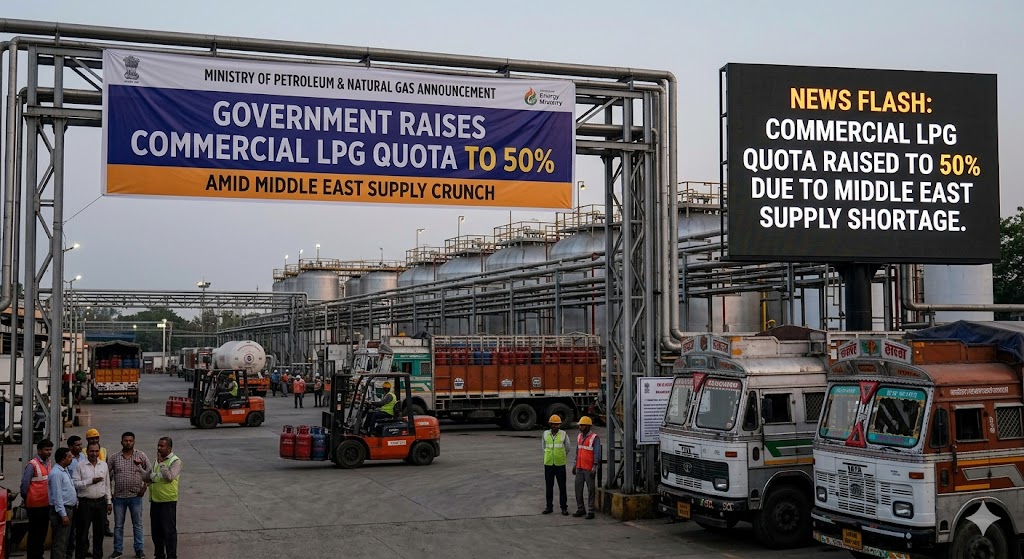
The Ministry of Petroleum and Natural Gas has announced a further 20% increase in the commercial LPG allocation for restaurants, hotels, industrial canteens, food-processing units, and community kitchens — bringing the total restored quota to 50% of pre-crisis consumption levels. The move comes weeks after supplies to commercial establishments were slashed to just one-fifth of normal levels in response to disruptions triggered by a three-week armed conflict in the Middle East.
The relief, however, is conditional. Under the new framework, businesses seeking access to the expanded allocation must formally register with an Oil Marketing Company (OMC) and submit an application for a Piped Natural Gas (PNG) connection. The government described these requirements as part of a broader push to accelerate India’s transition away from cylinder-dependent fuel consumption.
Stats: 50% Total quota restored | 3,500+ Anti-hoarding raids conducted | 1,400 LPG cylinders seized | 611 Indian seafarers in W. Persian Gulf
At the outbreak of hostilities in West Asia — centred on the Iran-Israel conflict — the central government moved to ringfence domestic cooking gas supplies. In several states, including Delhi, commercial LPG availability was reduced to roughly 1,800 cylinders per day, a fraction of ordinary demand. Priority was assigned to household users to prevent shortages in residential areas. A first tranche of 30% was restored as the situation stabilised; the latest announcement adds another 20 percentage points.
“Domestic LPG supply remains stable. There is currently no shortage for household consumers across the country.”
TRANSITION TO PIPED GAS
The government’s decision to tie commercial relief to PNG applications signals a deliberate structural shift. Officials have urged state administrations to fast-track approvals for City Gas Distribution networks, arguing that PNG connections will permanently reduce pressure on cylinder supply chains and insulate urban commerce from future geopolitical shocks. An additional 10% supply had earlier been promised to states contingent on progress in piped gas rollout — a benchmark that several states are now racing to meet.
SUPPLY & PRODUCTION MEASURES
Government Response at a Glance:
- All domestic refineries operating at peak capacity to maximise output.
- Adequate crude oil reserves maintained; no petrol or diesel shortages reported at retail outlets.
- Priority natural gas supply fully maintained for domestic PNG consumers and CNG transport.
- Industrial consumers receiving approximately 80% of normal natural gas supply.
- Booking intervals for LPG cylinders extended to distribute demand more evenly.
- Additional kerosene allocations released to states as an interim alternative fuel.
- Commitments made regarding LPG supply support for migrant workers.
ENFORCEMENT & ANTI-HOARDING CRACKDOWN
Alongside the supply measures, the government has mounted an aggressive enforcement campaign. States and Union Territories have been directed to maintain strict vigilance against hoarding and black-market trading of LPG cylinders. Nationwide, more than 3,500 raids have been conducted, resulting in the seizure of approximately 1,400 commercial cylinders. Most states have established dedicated control rooms and district-level monitoring committees to track distribution and flag irregularities in real time.

MARITIME WATCH
On the diplomatic and maritime front, the government reported that 22 Indian-flagged vessels and 611 seafarers remain positioned in the Western Persian Gulf region. Officials confirmed that no untoward incidents had been reported over the preceding 24 hours, offering cautious reassurance about the safety of Indian assets in the conflict zone — and by extension, the crude oil transit routes that feed the country’s refineries.
With production ramping up, enforcement tightening, and a phased restoration of commercial quotas underway, officials say the acute phase of the crisis appears to be easing. Whether the conditions attached to the new allocation — PNG applications and OMC registration — prove a bureaucratic bottleneck or a genuine catalyst for infrastructure modernisation remains to be seen.






Leave a Reply