

Weapons and ammunition for drones to be manufactured in Army workshops; Western Command spearheads initiative in dedicated mission mode as India accelerates self-reliance in drone warfare.
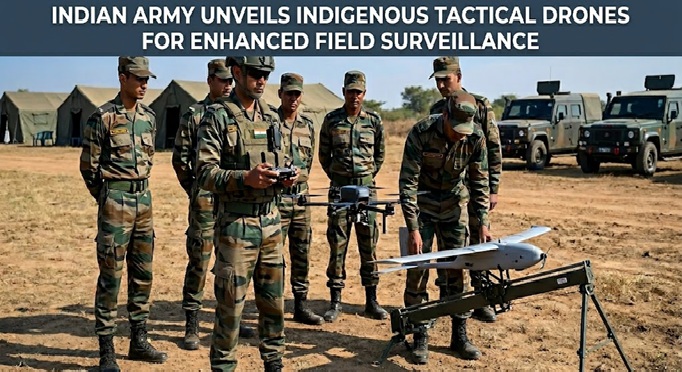
The Indian Army has launched a sweeping drive to embed drone warfare capabilities across every regiment of its force, with specialized strike detachments to be raised, trained, and equipped entirely through indigenous means. Operating under the aegis of the Western Command, the initiative is being executed in full “mission mode” — an organisational posture that signals both urgency and top-level priority.
At the core of this effort lies a commitment that goes beyond merely assembling drones: the Army has resolved that the ammunition and weapons integrated into these platforms will also be manufactured within its own regimental workshops. Officials describe the move as a decisive step toward building a self-sustaining, end-to-end indigenous drone ecosystem — from airframe to warhead.
“Drones and anti-drone technology will determine the outcome of wars in the times to come.”— Col. Harbaksh Singh, Defence Analyst
The strategic impetus, according to senior officials, stems from a frank reading of contemporary geopolitics. The grinding attrition of the Russia-Ukraine conflict and the aerial exchanges between Iran, Israel, and the United States have furnished the Indian military with a real-time laboratory of modern warfare — one whose lessons are being absorbed and operationalised at speed.
A Drone Hub at the Heart of the Western Command
Central to the restructuring is the transformation of the Western Command’s pivotal Khadga Corps into a dedicated drone hub. From this nucleus, the Command intends to radiate expertise outward — constituting small, highly specialised detachments proficient in drone operations and warfare across all regiments under its purview. These units will be accorded a distinct identity, reflecting their role as the cutting edge of a new warfighting doctrine.
Personnel from the technical wings stationed across various regimental workshops are already engaged in drone production on a scale officials describe as record-breaking. Each drone is engineered to precise operational parameters — range, payload capacity, physical dimensions, and mission utility — tailored to the specific demands of the terrain and threat environment the unit is expected to face.
- Specialised drone strike detachments to be raised within every regiment under Western Command
- Ammunition and weapons for drones to be indigenously manufactured in Army workshops
- Khadga Corpsto be transformed into a dedicated drone hub
- Design specifications calibrated to specific operational requirements — range, payload, and mission type
- Initiative gained significant momentum following Operation Sindoor
- Detachments to receive a distinct organisational identity
Post-Operation Sindoor: A Surge in Production
A military official from the Western Command noted that the initiative received a substantial acceleration following Operation Sindoor, after which drone production surged to record levels. The operational insights gathered during that deployment appear to have sharpened the Army’s understanding of exactly what configurations and capabilities are most needed — feeding directly back into the design and manufacturing pipeline.
“Officers and soldiers from technical branches are working with considerable skill and dedication,” the official said, adding that the integration of indigenously developed weapons into these platforms marks a qualitatively new phase in India’s defence self-reliance — one that moves the needle from assembling systems to manufacturing the means of lethality itself.
The Strategic Calculus: Reducing Foreign Dependence
Defence analyst Colonel Harbaksh Singh framed the initiative in stark terms. Citing the lessons of Ukraine and the Middle East, he argued that drone and counter-drone technology has already graduated from an auxiliary capability to a primary determinant of battlefield outcomes. In that context, he said, the Army’s move to manufacture drones — and the weapons they carry — in-house is not merely prudent; it is strategically indispensable.

“This is a challenging endeavour,” Col. Singh acknowledged, “but it will significantly reduce our reliance on foreign sources and strengthen our overall defence posture.” The initiative, he added, is consistent with the broader national vision of Atmanirbharta — self-reliance — in defence technology, translating a political commitment into operational reality at the regimental level.
With specialized units taking shape, workshops humming with production, and a corps headquarters being reoriented as a drone nerve centre, the Indian Army’s message is unmistakable: the drone age of warfare has arrived, and India intends to fight it on its own terms.









Leave a Reply