

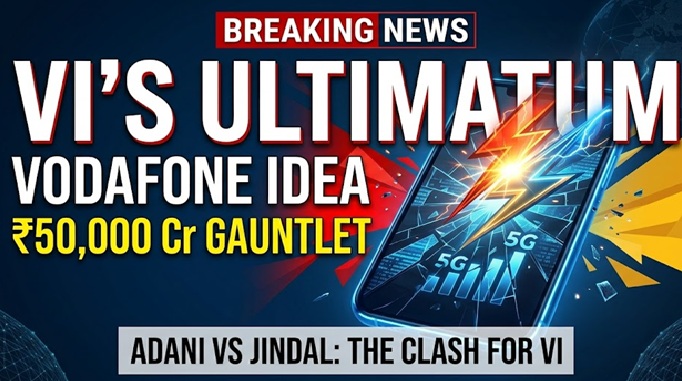
MUMBAI – The Indian telecom sector is bracing for what could be the most significant corporate restructuring in a decade. Vodafone Idea (Vi), once a dominant market leader, is currently standing on a precipice, desperately seeking a ₹50,000 crore capital infusion to transform from a struggling legacy brand into a 5G-ready powerhouse.
As the “scorching desert” of its balance sheet waits for a saviour, the industry is abuzz with a singular question: Who will bring the water?
The Anatomy of a Crisis: How We Got Here
The fall of Vi is a cautionary tale of aggressive competition and regulatory hurdles. The “tsunami” began in 2016 with the entry of Reliance Jio, which disrupted the market with free data and voice, rendering the gold-standard pricing of Vodafone and Idea obsolete.
-
The Merger That Faltered: In 2018, the merger of Vodafone India and Idea Cellular was meant to create a “2+2=11” synergy. Instead, technical friction and a massive culture clash saw millions of subscribers migrate to Airtel and Jio.
-
The AGR Thunderbolt: A Supreme Court ruling on Adjusted Gross Revenue (AGR) dues saddled the company with billions in debt. By early 2026, while the government has provided some relief by converting dues into equity, the immediate need for infrastructure capital remains dire.
The New “Sultans” in Waiting: Adani or Jindal?
The restructuring is complete, and the ground is prepared. Now, two of India’s most powerful industrial houses are rumoured to be eyeing the “third chair” in the telecom boardroom.
1. The Sajjan Jindal Factor
Sajjan Jindal’s JSW Group is the dark horse in this race. Known for his “aggressive expansion” DNA, Jindal has recently pivoted toward consumer-facing businesses, including electric vehicles. Telecom would be the final piece in his digital ecosystem puzzle. Analysts suggest JSW could lead a consortium to provide the necessary liquidity.
2. The Adani Ambition
Gautam Adani’s entry into the 5G auction was a shot across the bow. While his current focus remains on private captive networks, a strategic investment in Vi would turn the Indian telecom market into a historic battleground: Ambani vs. Adani. Such a move would leverage Adani’s vast data centre business with Vi’s massive consumer footprint.
The Fate of the Birla Legacy
For Kumar Mangalam Birla, the stakes are personal. The Birla family has already seen their stake diluted as the Government of India became the largest shareholder (nearly 49%). A new ₹50,000 crore investment would likely relegate the Birlas to “co-passengers” rather than owners—a bittersweet end to a decades-long telecom legacy, but perhaps the only way to keep the brand alive.
Why India Needs a Three-Way Fight
Beyond the corporate drama, the survival of Vi is a matter of national economic health. Today, the market is split into two distinct poles:
-
The Premium Class (Bharti Airtel): Focused on high-value users and increasing ARPU (Average Revenue Per User).
-
The Mass Class (Reliance Jio): Focused on sheer volume and bringing a smartphone to every hand.
The Duopoly Danger: If Vi collapses, India descends into a duopoly. History proves that without a third player, consumer choice vanishes, and pricing power rests solely with the two giants. Furthermore, the banking sector—already holding thousands of crores in Vi debt—cannot afford a default of this magnitude.

Verdict: The Final Call
Vodafone Idea is at a juncture where it will either stage a grand comeback or become a footnote in corporate history. With 5G rollout lagging and the cash burn continuing, the entry of a new “Telecom Sultan” isn’t just a possibility—it’s a necessity.
The last card is yet to be revealed, but the clock is ticking. For Vi’s millions of customers and investors, the “signal bars” of hope are currently being held up by the anticipation of a massive check.



Leave a Reply