

HMEL, the Bathinda-based joint venture between HPCL and Mittal Energy, announces a sweeping digital expansion — backed by ₹60,000 crore in cumulative Punjab investment and a bold new downstream industrial vision.
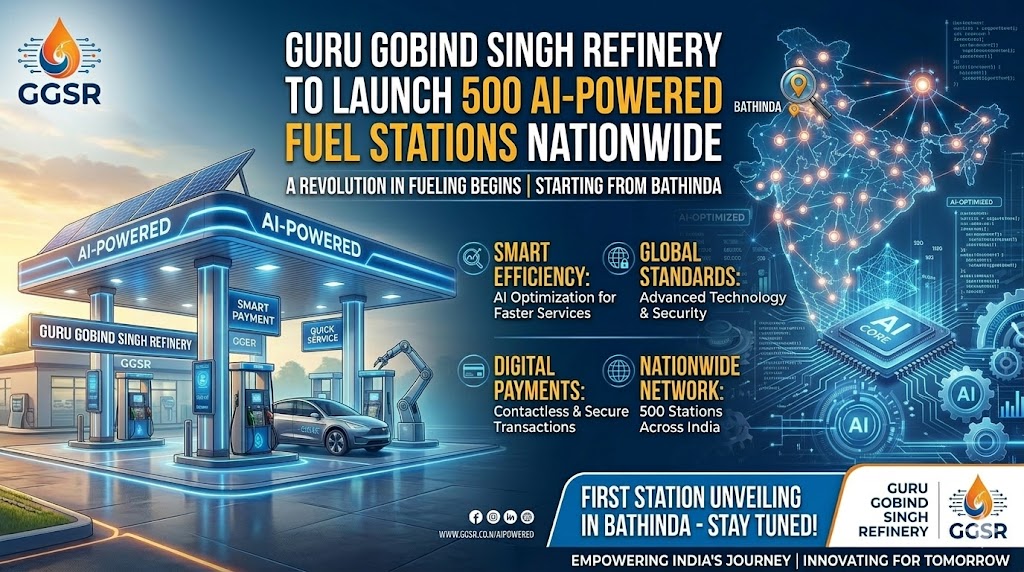
BATHINDA — In a landmark move that signals a new chapter for Punjab’s industrial landscape, HPCL Mittal Energy Limited (HMEL), operators of the Guru Gobind Singh Refinery, has announced plans to establish 500 artificial intelligence-powered petrol pumps across India — with the inaugural rollout set to begin in Bathinda, the very city that houses the refinery.
The announcement came on the heels of a high-profile meeting between ArcelorMittal’s Executive Chairman, Lakshmi Niwas Mittal, and Punjab Chief Minister Bhagwant Mann at the latter’s residence in Chandigarh on Friday. Industries Minister Sanjeev Arora was also present, and urged Mittal to deepen his investments in the state.
“This marks just the beginning for Punjab. A vast downstream ecosystem could potentially be developed around the refinery and petroleum facility.” — Lakshmi Niwas Mittal, Executive Chairman, ArcelorMittal
The AI-integrated fuel stations are expected to feature automated payment systems, intelligent inventory management, and vehicle recognition technology — representing a significant leap from conventional petrol pump operations. The stations are to be rolled out across multiple cities nationwide once the Bathinda pilot is established.
A Refinery Reinvented
Founded in 2008 as a joint venture between Hindustan Petroleum Corporation Limited (HPCL) and Mittal Energy Limited, the Guru Gobind Singh Refinery has grown into one of North India’s most critical energy infrastructure assets. Originally built with a processing capacity of 9 million metric tonnes (MMT), the facility has since been expanded to 13.5 MMT to meet surging regional demand.
To date, cumulative investment in the Punjab facility has surpassed ₹60,000 crore. The refinery produces petrol, diesel, and LPG not only for Punjab’s domestic consumption, but for a swathe of neighbouring states — making Bathinda a quiet but consequential node in India’s northern energy grid.
Specialty Chemicals, Green Energy Next
Looking ahead, HMEL is entering the field of specialty and fine chemicals, with a fresh investment of ₹2,600 crore earmarked for Punjab in the coming phase. The company is simultaneously expanding into renewable and sustainable energy initiatives — marking a deliberate pivot toward greener operations.
Bathinda is also home to what is described as the nation’s first refinery-integrated bio-ethanol plant. The facility currently produces approximately 100 million litres of ethanol annually, forming the backbone of the region’s ethanol-blended petrol programme — a central pillar of India’s clean fuel agenda.
A 1,500-Acre Downstream Vision
Perhaps the most ambitious element of the announcement is the state government’s plan to establish a downstream industrial complex spanning 1,500 acres in Bathinda. Chief Minister Mann confirmed the proposal during his meeting with Mittal, positioning it as a transformative opportunity for the city’s economic future.
Downstream petroleum activities encompass the refining of crude oil, the processing of raw natural gas, and the marketing and distribution of derived products. Mittal envisioned that an entire manufacturing ecosystem — encompassing plastic processing, chemical packaging, automotive complexes, and textile facilities — could be built around the refinery’s output.
Chief Minister Mann reaffirmed the Punjab government’s commitment to providing full support to any expansion Mittal chooses to undertake within the state, signalling strong political will behind the industrial transformation of Bathinda.

HMEL at a Glance
- ₹60,000 Cr+ — Total investment in Punjab to date
- 13.5 MMT — Current refinery processing capacity
- 500 — AI-powered petrol pumps planned nationwide
- 100M L — Ethanol produced annually at Bathinda plant
- ₹2,600 Cr — New investment in specialty chemicals
- 1,500 Acres — Proposed downstream industrial complex
States Supplied by Bathinda Refinery Punjab · Himachal Pradesh · Haryana · Delhi-NCR · Uttarakhand · Uttar Pradesh · Jammu & Kashmir · Madhya Pradesh
Key Milestones
- 2008 — Refinery established, 9 MMT capacity
- 2008–25 — Capacity expanded to 13.5 MMT
- 2024 — India’s first refinery bio-ethanol plant commissioned
- 2026 — 500 AI petrol pumps announced; green energy push begins
Downstream Sectors Proposed Plastic processing & chemical packaging · Automotive component manufacturing · Textile & synthetic fibre facilities · Specialty & fine chemicals · Renewable & green energy units





Leave a Reply