

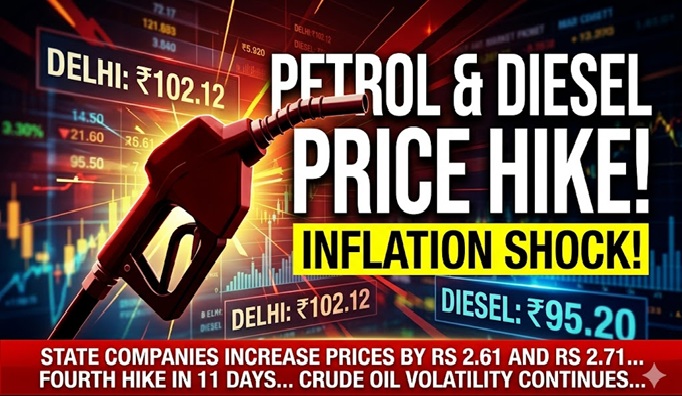
NEW DELHI: Fuel prices in India faced another significant surge on Monday as state-owned oil marketing companies announced the fourth price hike in just 11 days. The ongoing inflationary pressure has pushed petrol prices in the national capital past the ₹100-per-litre mark, reflecting a continued trend of volatility in the domestic energy market.
Effective from 6:00 AM today, Monday, May 25, 2026, the price of petrol has been increased by ₹2.61 per litre, while diesel saw a hike of ₹2.71 per litre. With this latest revision, petrol in Delhi is now retailing at ₹102.12 per litre, and diesel stands at ₹95.20 per litre.
A Rapid Upward Trend
Since the current cycle of price adjustments began on May 15, consumers have faced consistent upward pressure at the fuel pumps. The following table illustrates the recent sequence of price hikes:
| Date | Petrol Increase (per litre) | Diesel Increase (per litre) |
| May 15 | ₹3.00 | ₹3.00 |
| May 19 | ₹0.90 | ₹0.90 |
| May 23 | ₹0.87 | ₹0.91 |
| May 25 | ₹2.61 | ₹2.71 |
The Root Cause: Global Tensions and OMCs’ Burden
Market analysts point to the lingering geopolitical instability in the Middle East as the primary engine driving these hikes. The ongoing friction between the U.S. and Iran has sent shockwaves through global energy markets. While crude prices previously soared to as high as $125 per barrel at the height of recent tensions, they have seen a slight cooling-off, with Brent crude trading at $99 per barrel and WTI crude at $92 per barrel as of Monday morning.
However, the primary motivation for these frequent hikes remains the heavy financial burden on state-owned oil companies. Before the current series of increases, oil marketing companies were absorbing daily losses estimated at ₹1,000 crore to shield consumers from record-high global crude prices.
Union Petroleum Minister Hardeep Singh Puri previously signalled that the financial health of these companies remains a critical concern. Projections suggest that the losses for oil marketing companies could climb to between ₹1 lakh crore and ₹1.25 lakh crore for the first quarter of the 2026-27 financial year if retail prices are not adequately aligned with international costs.

Economic Impact
The sustained increase in fuel prices is expected to have a ripple effect across the broader economy. Rising diesel costs, in particular, are anticipated to increase logistics and transportation expenses, which typically leads to higher prices for essential goods and food commodities. As the nation grapples with this inflation shock, households and small businesses are bracing for a period of tightened budgets and increased operational costs.










Leave a Reply