

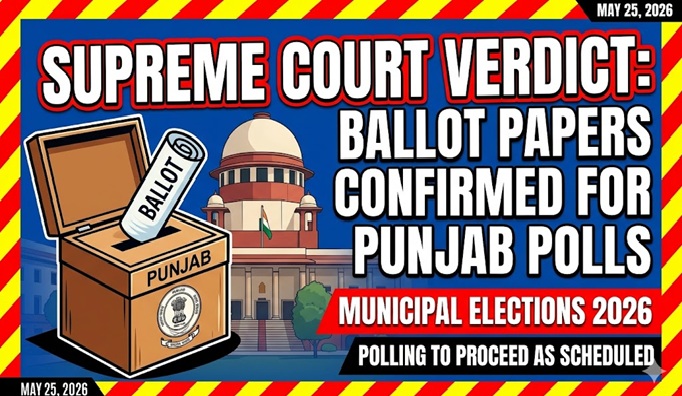
NEW DELHI – In a significant ruling just hours before the commencement of polling, the Supreme Court of India on Monday dismissed a petition challenging the use of ballot papers for the upcoming Punjab Municipal Corporation elections. The decision upholds the State Election Commission’s authority to determine the voting mechanism for local body polls.
A bench led by Chief Justice Surya Kant, along with Justices Joymalya Bagchi and Vipul M. Pancholi, emphasized that the electoral machinery was already in motion, making it legally and logistically inappropriate to intervene at the eleventh hour.
“No Reason to Second-Guess“
The petition had sought to mandate the use of Electronic Voting Machines (EVMs), arguing that they have become the established standard for elections in India. However, the apex court rejected the plea, noting that the Punjab Municipal Election Rules, 1994, explicitly provide for the use of both ballot papers and EVMs.
“The court cannot ‘second guess’ the decision of the State Election Commission,” Justice Joymalya Bagchi stated during the proceedings. The bench further clarified that because the Rules allow for ballot papers, the Commission is well within its rights to choose that method.
The Court also addressed concerns regarding potential electoral malpractice, observing that if a law and order problem were to arise, changing the voting technology would not necessarily be the remedy. Consequently, the bench also denied a secondary request to appoint a special election observer to monitor the polls.
A Consistent Judicial Stance
The Supreme Court’s ruling reinforces a previous decision made by the Punjab and Haryana High Court, which had similarly refused to interfere in the election process. In its earlier order, the High Court directed that any grievances regarding the election must be addressed through a formal election petition only after the voting process has concluded.

Context of the Dispute
The debate over the voting method arose as the state prepared for the municipal elections scheduled for May 26. While critics argued for the uniformity of EVMs, the State Election Commission maintained that all necessary logistical preparations for ballot paper voting were already finalized.
With the Supreme Court’s dismissal, the stage is now set for the polls to proceed as scheduled. Results are expected to be announced on May 29, 2026. Legal experts note that this ruling reaffirms the principle of non-interference in the democratic process once the election schedule has been officially notified.










Leave a Reply