

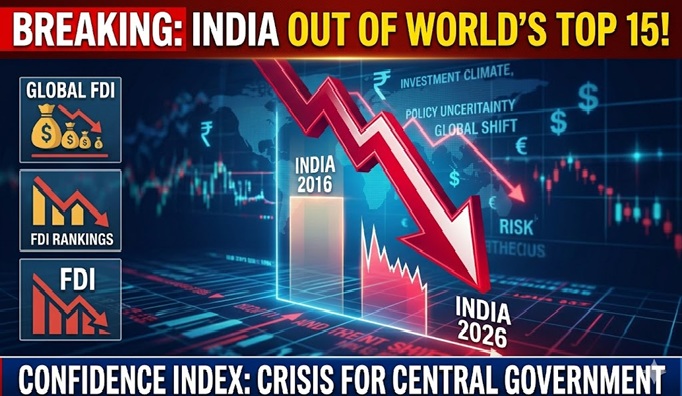
CHANDIGARH — India’s standing in the prestigious Kearney Foreign Direct Investment (FDI) Confidence Index has fallen out of the top 15 for the year 2026, triggering a sharp political confrontation between the opposition and the ruling administration.
Punjab Finance Minister Harpal Singh Cheema addressed the media on Thursday, characterizing the decline as a “deep crisis” of investor confidence under the current BJP-led central government. He argued that the data serves as a stark rebuttal to the government’s narrative of economic dominance.
The Declining Confidence Metric
The Kearney FDI Confidence Index is a global survey of international business executives, measuring their intent to invest in a country over the next three years. It is widely considered a bellwether for long-term economic stability and policy consistency.
-
2016 Standing: India was ranked among the world’s top 10 investment destinations, reflecting high global optimism regarding the nation’s economic trajectory.
-
2026 Standing: India has failed to secure a place in the top 15, signalling a shift in how global capital perceives the domestic market.
Finance Minister’s Critique
Minister Cheema alleged that there is a widening chasm between the government’s “propaganda-based claims” and the realities faced by global investors. In a statement posted on ‘X’ (formerly Twitter), he outlined several factors contributing to the slump:
“Agreements have remained on paper, the investment climate has weakened, policy uncertainty is increasing, and trade agreements are being made in a compromising position rather than in a firm one.”
Cheema further criticized the central government for prioritizing “headline-grabbing arrangements” over the substantive, structural economic reforms necessary to sustain long-term growth. He noted that as India’s appeal has waned, global capital is increasingly pivoting toward competitors like the UAE, Saudi Arabia, and South Korea.
The Economic Debate: Perception vs. Reality
The exit from the top 15 has reignited a broader debate among economists and analysts regarding the health of the Indian economy.
-
The Sentiment View: Critics align with Minister Cheema, noting that the decline in the index points to lingering concerns over regulatory hurdles, industrial momentum, and the gap between investment pledges and actual ground-level implementation.
-
The Inflow View: Conversely, proponents of the government’s economic policy highlight that while sentiment indices can be volatile, actual FDI inflows—the physical capital entering the country—remain robust. Data for the 2025-26 fiscal year has shown record-breaking gross FDI inflows exceeding $90 billion, which supporters argue proves that real-world investment activity remains strong regardless of qualitative sentiment rankings.

As the political discourse intensifies, the discrepancy between sentiment-based rankings and hard capital inflow data remains a central point of contention in India’s economic narrative for 2026.










Leave a Reply