

NEW DELHI – In what is being hailed as the most significant offensive against cyber-syndicates to date, the Government of India has unveiled a multi-agency “action plan” to dismantle the ‘digital arrest’ scam industry. Under the watchful eye of the Supreme Court, the Ministry of Home Affairs (MHA), the RBI, and tech giants are moving to turn the tide against fraudsters through a combination of biometric enforcement and rapid-response technology.
The Indian Cyber Crime Coordination Centre (I4C) submitted a detailed roadmap to a bench headed by Chief Justice Surya Kant, signalling an end to the era of untraceable “fake” SIM cards and unchecked VoIP fraud.
The End of Anonymous Calling: Biometric Mandates
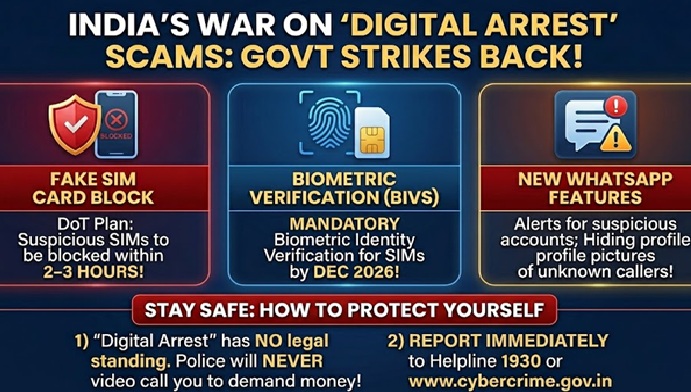
At the heart of the government’s strategy is the Biometric Identity Verification System (BIVS). Targeted for full implementation by December 2026, this system will mandate real-time biometric verification for every SIM card issued in the country.
By linking SIM issuance to live biometric data, authorities aim to eliminate the “bulk-purchased” fake identities that scammers currently use to stay anonymous. Furthermore, the Department of Telecommunications (DoT) has established a “Kill Switch” protocol to block suspicious SIM cards within 2–3 hours of a scam being reported.
WhatsApp: New Shields Against ‘Digital Dacoity’
With WhatsApp serving as the primary tool for scammers to impersonate police officials, the platform has reported the banning of 9,400 accounts in the last 12 weeks alone. To further protect users, WhatsApp is developing:
-
Identity Alerts: Real-time warnings when a call originates from a “low-tenure” or suspicious account.
-
Automated Logo Protection: A feature that will hide profile pictures of unknown callers to prevent scammers from using fake CBI, Police, or Customs badges to intimidate victims.
Financial “Muzzle” on Money Mules
The Reserve Bank of India (RBI) has issued a new Standard Operating Procedure (SOP) for all domestic banks. This directive focuses on the “Money Mule” networks—the web of accounts used to funnel and hide stolen money.
-
Immediate Transaction Freezing: Banks are now authorized to halt suspicious transfers instantly without waiting for a formal FIR, buying precious time for victims to recover their funds.
-
CBI Takeover: For high-stakes fraud involving amounts over ₹10 crore, the Central Bureau of Investigation (CBI) will now take over jurisdiction to track international money laundering trails.
The Human Toll
The Supreme Court’s suo motu intervention comes in the wake of escalating cases where victims were kept under “virtual surveillance” for days, coerced into transferring life savings. One recent Delhi case saw an individual defrauded of a staggering ₹22.92 crore.
Official Advisory: What Is a ‘Digital Arrest’?
Authorities are reminding the public that “Digital Arrest” has no legal standing.
-
Law enforcement will never contact you via video call to demand money or keep you “confined” via your screen.
-
Verification: If you receive a call claiming your Aadhaar or phone number is linked to illegal activities, hang up immediately.
-
Reporting: Victims should call the national helpline 1930 or visit www.cybercrime.gov.in within the “golden hour” (the first 60 minutes) to maximize the chances of freezing the stolen funds.

The Centre has requested the Supreme Court to issue binding directives to telecom companies, ensuring that the 2026 biometric deadline is met with zero exceptions, marking a new chapter in India’s digital sovereignty.









Leave a Reply