

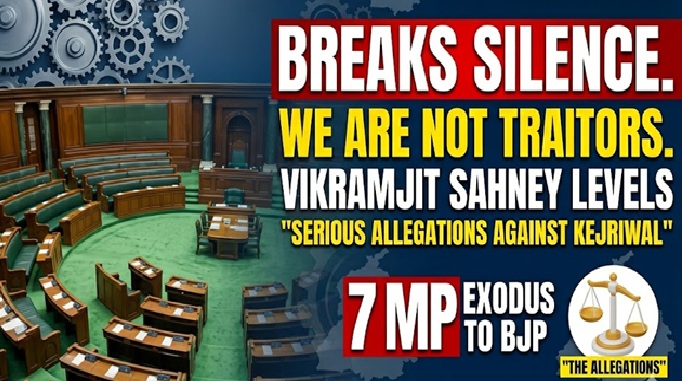
NEW DELHI – Breaking his silence days after a tectonic shift in Punjab politics, Rajya Sabha MP Vikramjit Singh Sahney has fired a scathing broadside at Aam Aadmi Party (AAP) supremo Arvind Kejriwal. Sahney, who was among seven MPs who merged with the Bharatiya Janata Party (BJP) last Friday, dismissed “traitor” labels and alleged that the party has become a “sinking ship” due to internal side-lining and a toxic “confrontationist” culture.
The Meeting with Kejriwal: “He Told Me to Resign”
In a candid revelation, Sahney detailed a high-stakes meeting with Kejriwal held on Wednesday, April 22, 2026, just 48 hours before the mass defection. Sahney claimed he warned the AAP convenor of a brewing rebellion, noting that the group had already secured the two-thirds majority (7 out of 10 MPs) required to bypass the anti-defection law.
“During the meeting, he asked me if I was under any pressure. I told him clearly, ‘No.’ He then suggested that I should consider resigning from my seat. I told him I would think about it, but after consulting my associates, I realized resignation wasn’t the answer—Punjab was,” Sahney stated.
The “Side-lining” of Key Architects
Sahney attributed the exodus to the marginalization of the original architects of the 2022 Punjab victory, Raghav Chadha and Sandeep Pathak. He alleged that after AAP’s defeat in the 2025 Delhi Assembly elections, a “new team” took control, effectively stripping the veteran leaders of their influence.
The final straw for many, Sahney noted, was the removal of Chadha as the Deputy Leader in Parliament. “When leaders like Pathak and Chadha were reduced to zero, a sense of deep frustration spread among all of us. We felt we were no longer able to serve Punjab effectively under the current leadership,” he added.
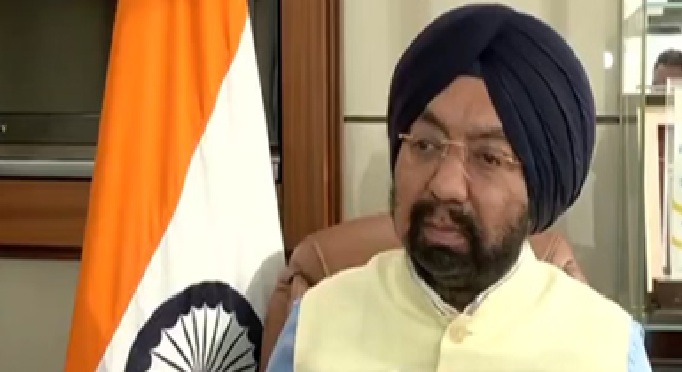
“Punjab is in the ICU”
Defending his move to the BJP, the philanthropist-turned-politician painted a grim picture of his home state’s economy, describing it as being in the “ICU.” He cited a staggering state debt of ₹4.5 lakh crore and a youth population trapped in drug addiction due to a lack of industrial jobs.
-
Agricultural Crisis: Sahney warned that the younger generation is increasingly reluctant to engage in farming.
-
Lack of Coordination: He accused the AAP government of being in “permanent election mode,” choosing “grudge politics” over constructive dialogue with the Centre.
-
The BJP Solution: Sahney argued that only the BJP-led Central Government can provide the necessary freight subsidies and infrastructure proposals—backed by concrete data—to save the state from financial collapse.

The Aftermath: A Numbers Game
The merger, which was officially accepted by Rajya Sabha Chairman CP Radhakrishnan today, has altered the balance of power in the Upper House:
-
BJP Strength: Rises to 113.
-
AAP Loss: Reduced from 10 members to just 3 (Sanjay Singh, ND Gupta, and Balbir Singh Seechewal).
While the AAP has labelled the defectors as “traitors” and moved a petition for their disqualification, Sahney remained defiant. “Anyone can say what they want, but the people of Punjab are discerning. We will work ten times harder to prove that our priority has always been, and will always be, the welfare of Punjab.”
With the 2027 Punjab Assembly elections looming, Sahney’s departure—alongside heavyweights like Harbhajan Singh and Raghav Chadha—marks a significant realignment that could redefine the political future of the state.








Leave a Reply