

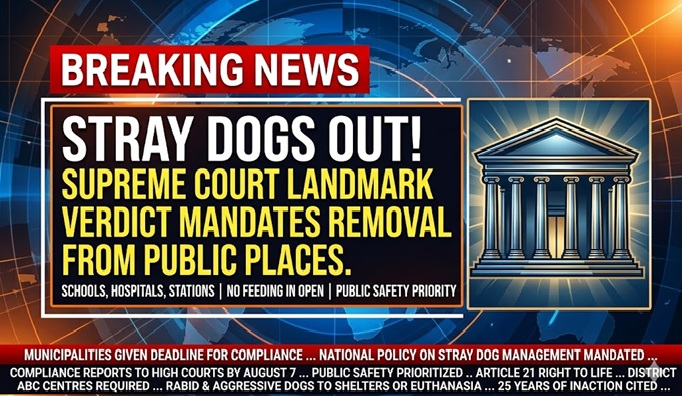
NEW DELHI – In a move aimed at balancing animal welfare with public safety, the Supreme Court of India on Tuesday dismissed a series of petitions filed by animal welfare organizations and dog enthusiasts. The Court’s judgment, which upholds and strengthens the existing Standard Operating Procedures (SOPs) for the management of stray dogs, marks a decisive shift in how municipal bodies are expected to handle the growing menace of canine-related public health incidents.
A “Humanitarian Crisis”
The bench did not mince words regarding the urgency of the situation, noting that the judiciary could no longer remain a bystander while incidents of dog bites—particularly those involving women and children—continue to surge nationwide.
Citing alarming statistics from states like Rajasthan and Gujarat, the Court highlighted that the stray dog population has reached a critical threshold. In Sri Ganganagar, Rajasthan, officials reported over 1,000 dog bite incidents in a single month, while Tamil Nadu recorded over 200,000 cases in just four months. The Court described these figures as evidence of a “humanitarian crisis” caused by decades of administrative apathy.
Key Mandates of the Verdict
The ruling effectively outlines a tiered approach to managing stray dog populations across the country:
-
Institutional Zones: Stray dogs are to be removed from high-density, sensitive zones including schools, colleges, hospitals, bus stands, railway stations, and sports complexes.
-
The ABC Framework: While the Animal Birth Control (ABC) rules of 2001 remain the guiding principle for sterilization and vaccination, the Court criticized the “lack of planning” in their execution. Municipal corporations are now mandated to ensure that healthy, sterilized dogs are returned only to the specific areas from which they were captured.
-
Safety of Public Spaces: Feeding stray dogs on public roads, streets, and open spaces is now prohibited. Municipal bodies must establish clearly marked “feeding zones” in every locality to concentrate feeding activities and minimize human-canine conflict.
-
Aggressive and Rabid Dogs: The Court provided clear directives for the treatment of dogs exhibiting dangerous behavior or signs of rabies. These animals are not to be released back into the community; instead, they are to be isolated in specialized shelter facilities.
-
National Policy: The Court has ordered the formulation of a uniform national policy on stray dog management to replace the fragmented, state-by-state approach that has largely failed to curb the population.
Two Decades of Inaction
The Supreme Court expressed severe disappointment with state governments and local agencies, noting that while the ABC framework was enacted 25 years ago, the necessary infrastructure—such as shelters and surgical clinics—has remained woefully inadequate.
“If the state governments had acted with foresight, the present situation would not have arisen,” the bench remarked. The ruling emphasizes that the failure of authorities to scale resources alongside the growing dog population has forced the Court to step in with more stringent, actionable directives.

Moving Forward
With this verdict, the onus for implementation now lies squarely with municipal corporations and state agencies. The Court has made it clear that the objective is to move away from uncoordinated, ad-hoc measures toward a systematic, nation-wide policy that prioritizes the safety of citizens while maintaining the humane treatment of animals.
As municipal bodies begin to prepare for the implementation of designated feeding zones and expanded shelter infrastructure, the ruling serves as a final warning that the status quo of “inadequate measures” is no longer acceptable.













Leave a Reply