

SRINAGAR/JAMMU – In a significant move toward administrative austerity and environmental sustainability, the High Court of Jammu & Kashmir and Ladakh has announced a sweeping transition to virtual court proceedings and a hybrid work model, effective tomorrow, May 21, 2026.
The directive, issued by the Registrar General of the High Court, comes as a direct response to Prime Minister Narendra Modi’s recent national appeal for fuel conservation and the promotion of economic self-reliance across governmental institutions.
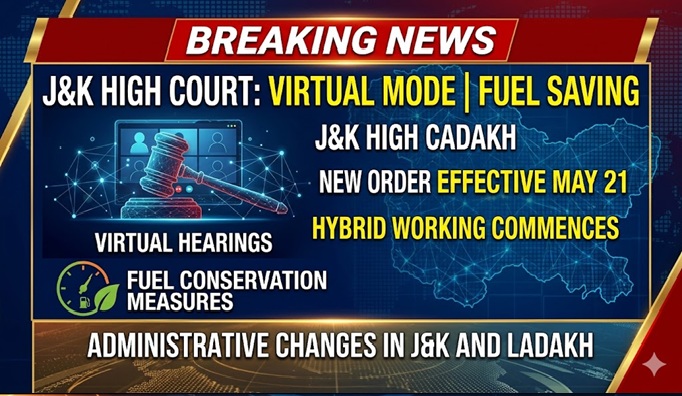
Virtual Transformation of Judiciary
Beginning May 21, the High Court will transition to a digital-first approach for all judicial matters. While the court is promoting virtual appearances for legal practitioners to curtail unnecessary travel, officials have built in flexibility for the legal fraternity.
“Lawyers are encouraged to utilize online platforms for their appearances,” the circular stated. “However, the court recognizes that certain circumstances may be compelling, and physical appearances will remain permissible where strictly necessary.”
This digital mandate extends to the upcoming summer break. The court has confirmed that all matters brought before the vacation benches—which commence operations on June 8—will be conducted exclusively in virtual mode.
Administrative Austerity Measures
Beyond courtroom proceedings, the High Court has implemented a series of austerity protocols aimed at optimizing resource utilization:
-
Virtual Capacity Building: All training programs, workshops, and orientation sessions organized by the Judicial Academy have been shifted to a permanent online format.
-
Inspections and Meetings: Administrative inspections of districts and official inter-departmental meetings are now mandated to occur via secure online platforms until further notice.
-
Travel and Transport: In a move to reduce the state’s carbon footprint and operational costs, administrative officers have been instructed to practice vehicle pooling for all official transit.

Suspension of LTC Facility
Perhaps the most notable fiscal measure is the temporary suspension of the Leave Travel Concession (LTC) facility for all judicial officers and court staff. This suspension is immediate and will remain in effect until further orders. To ensure that staff rights are protected, the court has indicated that the relevant LTC block period will be adjusted proportionally for the duration of the suspension.
Legal experts view this move as a bold step by the judiciary to lead by example in national austerity efforts. By leveraging the technological infrastructure developed over recent years, the High Court aims to maintain the efficiency of the justice system while significantly reducing its energy consumption and logistical expenditure.
The order remains effective “until further orders,” signalling a potential long-term shift in how the High Court of Jammu & Kashmir and Ladakh manages its judicial and administrative functions.










Leave a Reply