

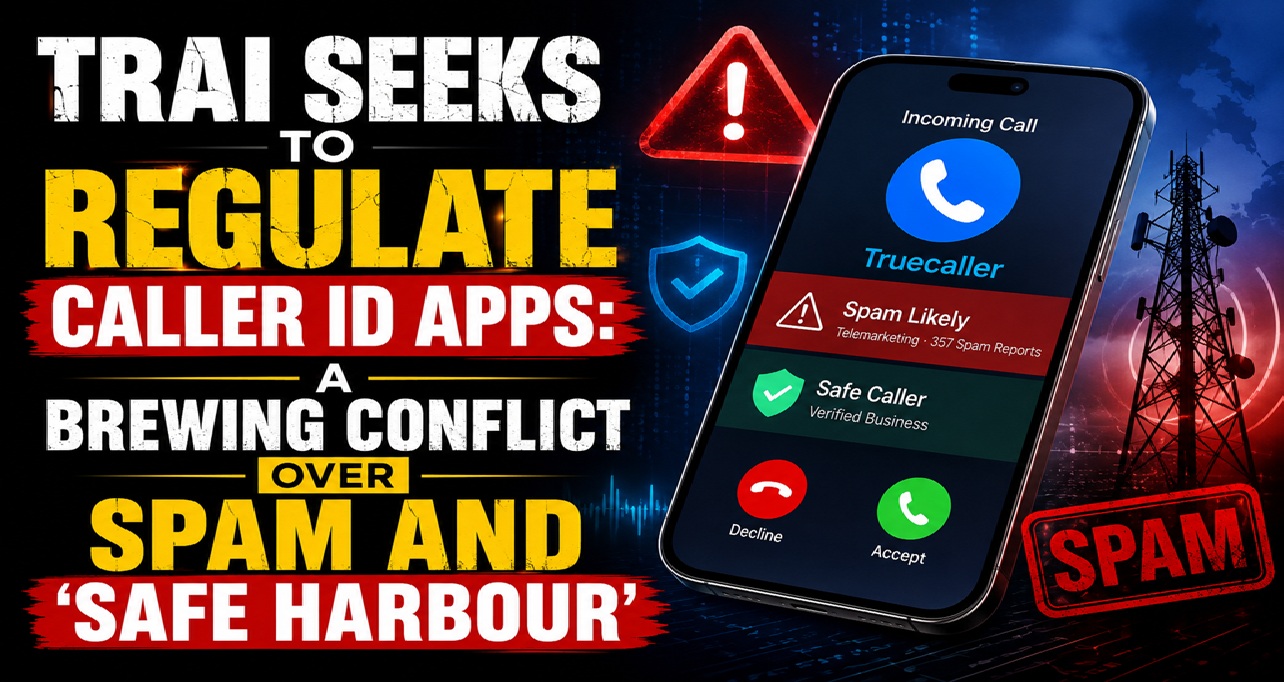
NEW DELHI – In a move that could fundamentally alter how millions of Indians manage their mobile communications, the Telecom Regulatory Authority of India (TRAI) is seeking government authorization to exert direct regulatory control over popular caller management apps, including Truecaller.
The standoff, which reached a flashpoint this week, centres on the balance between preventing fraudulent calls and maintaining the independence of third-party utility applications.
The Regulatory Push
TRAI has formally requested that the Ministry of Electronics and Information Technology (MeitY) empower it to regulate the operations of call management apps. Currently, these platforms operate as intermediaries under the IT Act, enjoying “safe harbour” protections that shield them from liability for user-generated content or community-driven data.
The proposal is embedded within the ‘Draft Telecom Commercial Communication Preference (Third Amendment) Regulations, 2026’. If approved, the regulation would prohibit these apps from tagging, filtering, or blocking incoming calls that originate from specific number series designated for commercial purposes—namely the ‘140’ (telemarketing) and ‘1600’ (service/transactional) series.
Why TRAI is Acting
TRAI officials argue that by labelling or blocking calls from these designated series, third-party apps are interfering with legitimate commercial communications. The regulator maintains that banks, financial institutions, and insurance companies use these series to reach customers for essential services. By allowing apps to mark these numbers as “spam,” the regulator claims that important information is being suppressed, potentially impacting the efficiency of the formal financial sector.
Truecaller’s Sharp Rebuttal
Rishit Jhunjhunwala, CEO of Truecaller, has launched a scathing critique of the proposed regulations, calling the regulator’s approach “completely pointless.”
In a public statement, Jhunjhunwala highlighted a growing disconnect between regulatory policy and ground reality. “While the intention to issue a dedicated number series might look good on paper, there has been a massive surge in spam calls originating from the 140 and 1600 series,” he stated.
According to data cited by the company, more than 51 million calls from these specific series go unanswered by Indian users daily—a testament to the high volume of unwanted traffic originating from numbers the government intended to be “trusted.”
“We are a force for good, helping crores of Indians—including the elderly—experience trustworthy communication,” Jhunjhunwala added. “Instead, the move seems to favour bad actors, giving them a free hand to spam and scam people by censoring community-driven information. We cannot accept this.”
The Implications
The outcome of this request will have significant consequences for the digital ecosystem in India:
-
For Users: If the regulation is enforced, the spam-filtering efficacy of apps like Truecaller could be drastically reduced for calls originating from the 140/1600 series, as apps would be legally required to treat these numbers as “genuine.”
-
For Tech Platforms: The loss of “safe harbour” protection would fundamentally change the business model of caller-ID apps, forcing them to align their algorithms with government-mandated white-lists or risk severe legal penalties.
-
For the Government: The Ministry of IT faces the challenge of reconciling the need for a seamless commercial communication channel with the public’s overwhelming demand for protection against a rising tide of sophisticated phishing and scam calls.

As discussions continue between TRAI and the Department of Telecommunications, the industry remains on high alert. The broader question remains: Should the entities that report the spam be regulated, or should the focus remain on the bad actors who are increasingly exploiting official channels to reach unsuspecting consumers?







Leave a Reply