

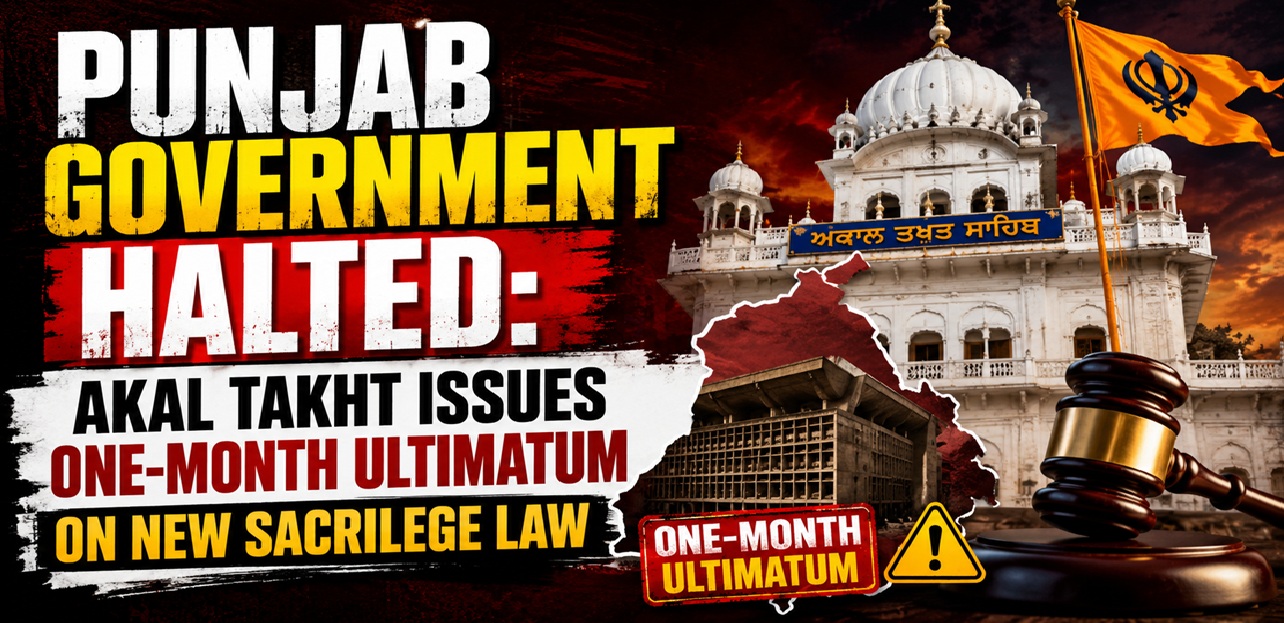
AMRITSAR, PUNJAB — In a significant development for the state’s legislative and religious landscape, the Jathedar of Sri Akal Takht Sahib, Giani Raghbir Singh (referred to as Jathedar Kuldeep Singh Gadgaj in reports), has directed the Punjab government to suspend the implementation of its newly passed sacrilege law.
Following a high-stakes hearing at the supreme temporal seat of the Sikhs on Monday, the Jathedar mandated that the government address all religious and legal objections to the law within a period of one month.
A “Long and Positive” Consultation
A delegation of Aam Aadmi Party (AAP) ministers and MLAs—including Assembly Speaker Kultar Singh Sandhwan and Finance Minister Harpal Singh Cheema—arrived at the holy site barefoot to present a written explanation regarding the legislation.
While the proceedings were described by government representatives as a “long and positive discussion,” the atmosphere remained firm regarding the sanctity of the institution. Officials refrained from disclosing the minute details of the deliberations, citing the decorum of the Akal Takht.
“We hold the highest reverence for Sri Akal Takht Sahib,” stated Finance Minister Harpal Singh Cheema. “We will fully respect the suggestions made by the Jathedar and ensure that all future proceedings are handled with deep sensitivity toward the religious sentiments of the Sikh community.”
The Core Mandates
The Jathedar’s directives have effectively put the brakes on the law’s enforcement, setting the following conditions:
-
Suspension of Implementation: The government is prohibited from moving forward with the law until the required amendments are integrated.
-
Mandatory Consultation: The Jathedar underscored that while the state has the constitutional right to legislate, matters impacting the Sikh faith require prior, formal consultation with the Akal Takht, the Shiromani Gurdwara Parbandhak Committee (SGPC), and other relevant Sikh institutions.
-
The One-Month Review: All amendments proposed by the Jathedar are to be channelled through the Speaker of the Punjab Assembly. The government has committed to reviewing these proposals in detail before the one-month deadline expires.
Unresolved Legal and Procedural Questions
The hearing also brought to light significant gaps in the government’s policy framework. The Jathedar specifically challenged a public statement made by Chief Minister Bhagwant Mann, which suggested that the parents or guardians of an individual who commits an act of sacrilege should be held liable if the perpetrator is found to be mentally ill.
When pressed on whether this provision existed within the letter of the law, Agriculture Minister Gurmeet Singh Khuddian was unable to provide a definitive legal clarification, fuelling further scrutiny of the bill’s drafting process.
The session also touched upon the principle of transparency. When an AAP MLA suggested that the hearing not be broadcast live due to its sensitive nature, the Jathedar pointedly reminded the delegation of the Chief Minister’s own prior advocacy for the live telecast of government proceedings, highlighting an apparent contradiction in the government’s approach to public accountability.

Looking Ahead
The government now faces a critical 30-day window to reconcile its legislative agenda with the concerns of the Sikh leadership. By demanding a collaborative approach, the Akal Takht has signalled that the path to enacting laws regarding sensitive religious issues must prioritize institutional consensus over unilateral government action.
As the state awaits the next steps, the political and religious spheres remain in a delicate balance, with the government’s next move expected to be a test of its willingness to integrate these mandated amendments into the state’s legal code.











Leave a Reply