

Union Ministry of Home Affairs orders immediate release, reaffirms commitment to peace and dialogue in the region
“Sonam Wangchuk’s detention has been revoked with immediate effect. He is now a free man and will not face any further legal proceedings.” — Ministry of Home Affairs, Government of India
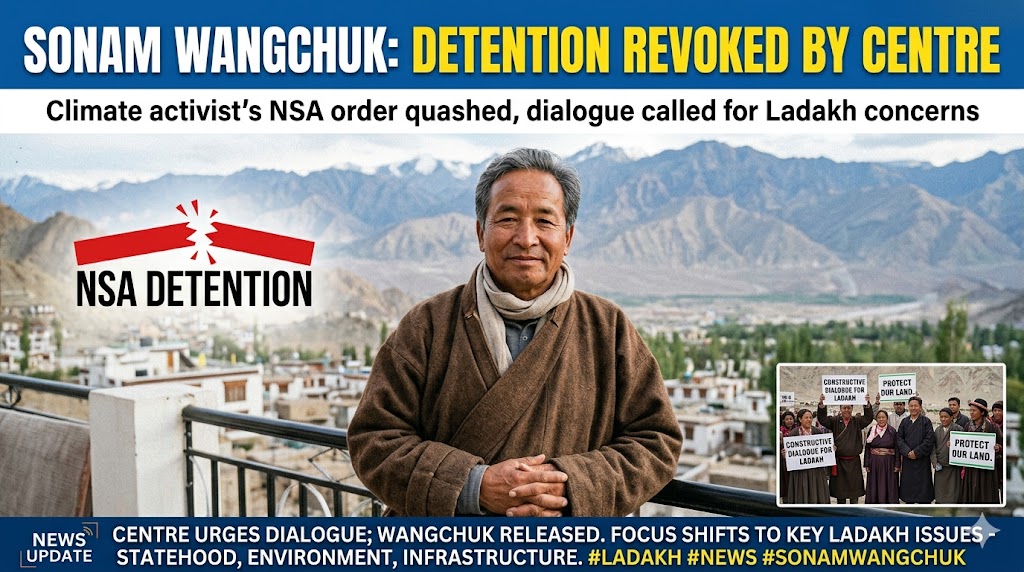
The Union Ministry of Home Affairs on Saturday ordered the immediate revocation of the detention of prominent climate activist and engineer Sonam Wangchuk, invoking powers under the National Security Act (NSA). The Ministry confirmed that Wangchuk is now a free man and will face no further legal proceedings arising from his detention.
The Ministry stated that the decision was taken with immediate effect and underscored the Central Government’s continued commitment to maintaining peace, stability, and mutual trust in the Union Territory of Ladakh.
Government Reaffirms Dialogue Commitment
Alongside announcing the release, the Ministry of Home Affairs reiterated its intent to pursue meaningful engagement with all concerned stakeholders in Ladakh. The government expressed a preference for resolving outstanding issues through established institutional channels, specifically citing the High-Level Committee and other appropriate forums as the most constructive platforms for dialogue.
The Ministry also gave assurances that all necessary security measures for Ladakh would continue to be provided, signalling that the release was not a relaxation of the government’s security posture in the strategically sensitive region.
Who is Sonam Wangchuk?
Sonam Wangchuk is a Ladakhi engineer, education reformer, and climate activist widely recognised as the real-life inspiration behind the beloved character “Funsukh Wangdu” in the 2009 Bollywood blockbuster 3 Idiots. Beyond popular culture, he is the founder of SECMOL (Students’ Educational and Cultural Movement of Ladakh) and is internationally recognised for his innovation of Ice Stupas — artificial glaciers designed to address water scarcity in high-altitude Himalayan regions.
In recent years, Wangchuk has emerged as the most prominent voice demanding full statehood for Ladakh and inclusion under the Sixth Schedule of the Constitution, which would grant greater autonomy and tribal protections to the region. His sustained activism and hunger strikes drew national attention to Ladakh’s political aspirations following the abrogation of Article 370 in 2019, which bifurcated the erstwhile state of Jammu & Kashmir into two Union Territories.
Detention Under NSA and Public Reaction
Wangchuk’s detention under the National Security Act — a law that allows preventive detention without trial for up to 12 months — had drawn sharp criticism from civil society groups, political leaders across party lines, and international observers. The use of the NSA against a figure of his stature and national goodwill was seen by many as disproportionate.
The revocation of his detention, framed alongside the government’s fresh assurances of dialogue, is widely seen as an attempt to de-escalate tensions in the region. However, political analysts caution that the true test will lie in whether substantive negotiations on Ladakh’s constitutional status follow in the coming weeks.

KEY FACTS AT A GLANCE
- Decision taken by: Union Ministry of Home Affairs
- Legal provision invoked: National Security Act (NSA)
- Effect: Immediate; no further legal proceedings
- Government stance: Peace, stability, and constructive dialogue in Ladakh
- Proposed forum: High-Level Committee and other appropriate channels










Leave a Reply