

A petitioner has urged the Punjab and Haryana High Court to stay the felling of thousands of trees — many over a century old — along the proposed Zirakpur–Panchkula Bypass, arguing that a mere 500-metre diversion could spare an irreplaceable green corridor
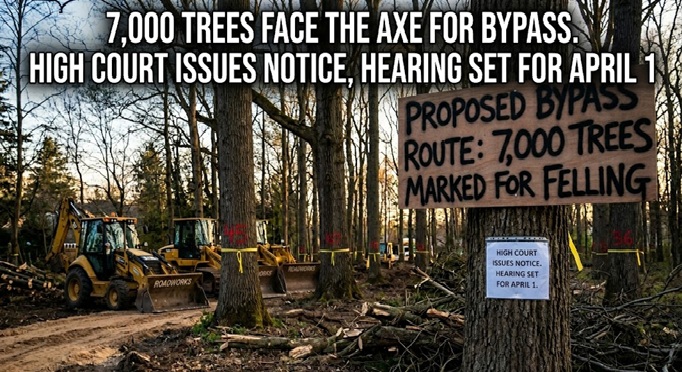
The Punjab and Haryana High Court has issued notices to the Central Government, the governments of Haryana and Punjab, and the National Highway Authority of India (NHAI), after a Public Interest Litigation was filed seeking a stay on the felling of approximately 7,000 trees earmarked for the proposed Zirakpur–Panchkula Bypass. The Court is scheduled to hear arguments on the stay demand on April 1.
Counsel for the petitioner informed the Court that the proposed highway is set to originate in Punjab and traverse through Haryana, threading through some of the most densely wooded stretches in the region. Many of the trees in question are over 100 years old, the petitioner’s counsel argued, making them an ecological resource that cannot be replicated within any meaningful timeframe.
“The damage could be entirely averted by a mere 500-metre diversion — and connectivity achieved using the existing National Highway-7.” — Petitioner’s Counsel, Punjab & Haryana High Court
Golf Course, Green Belt, and Wildlife at Risk
Presenting the proposed alignment to the Court through Google Maps imagery and field photographs, the petitioner detailed three specific zones of concern. A developed golf course area in Panchkula — home to approximately 14,000 trees — lies directly in the path of the planned highway, making the felling of around 3,000 trees a near-certain consequence. Several sections of the golf course are expected to be physically impacted by construction work.
A further 2,000 trees in the green belt of Sector 1-A, Panchkula, are also under threat. This area, the Court was told, has recorded the presence of wildlife, raising concerns about the disruption of local biodiversity corridors in addition to the direct loss of tree cover.
The ‘Tricity’ region — encompassing Chandigarh, Panchkula, and Mohali — functions as a vital green lung for the wider urban agglomeration. The petitioner argued that this zone plays a critical role in controlling air pollution, maintaining temperature equilibrium, and preserving the biodiversity of the Shivalik foothills edge.
The petitioner pointed out that connectivity between Zirakpur and Panchkula could instead be established by utilising existing National Highway-7 infrastructure, requiring only a 500-metre diversion from the proposed alignment — sparing the forest and green zones entirely.
A State Already at the Forest Floor
The Court was apprised of the dire state of Haryana’s existing forest cover. Citing the India State of Forest Report 2023, the petitioner highlighted that the state’s total recorded forest cover stands at a mere 3.65 percent — a figure that is not only drastically lower than the nationally prescribed target of 33 percent but also places Haryana among the states with the most depleted green cover in the country. Under these circumstances, the petitioner argued, large-scale felling would further destabilise an already fragile ecological balance.
Compensatory Plantation: 300 km Away, Low Survival Rate
The petitioner raised sharp concerns over the compensatory plantation scheme proposed to offset the felling. With insufficient land available within Haryana itself, authorities have planned the plantation in the Ferozepur region of Punjab — approximately 300 kilometres from where the trees are being felled. The Court was told that sapling survival rates in that region are reportedly quite low, undermining the ecological validity of the offset arrangement.
The petitioner argued that compensatory plantation hundreds of kilometres away does not and cannot restore the local ecosystem services — air quality, shade, temperature modulation, and wildlife habitat — provided by the existing canopy in the Panchkula area.
Tender Advanced, Permission Not Yet Granted
Crucially, the Court was informed that final permission for the felling of trees has not yet been granted by the relevant authority. Nevertheless, the tender process for the project had already advanced to a significant stage on March 20 — a sequence of events that the petitioner flagged as a cause for concern, given the risk of irreversible ground-level action before legal scrutiny is complete.
Following the High Court’s decision to take cognizance of the matter and issue notices, the implementation of the project now hangs in the balance pending the April 1 hearing, at which arguments on the stay application will be presented by all parties.
Tags: Zirakpur–Panchkula Bypass · NHAI · Deforestation · Punjab & Haryana HC · Tricity · PIL · Haryana Forest Cover

Key Figures
- 7,000 — Trees at risk of felling along the entire bypass alignment
- 3,000 — Trees potentially felled in Panchkula golf course alone
- 2,000 — Trees threatened in Sector 1-A green belt, Panchkula
- 100+ — Years old, age of many trees earmarked for felling
- 500 m — Diversion that petitioner says would save all threatened trees
- 300 km — Distance to planned compensatory plantation site in Ferozepur
Haryana Forest Cover: 3.65% (national target: 33%) — Source: India State of Forest Report 2023
Case Timeline
- March 20, 2026 — Tender process advanced for the bypass project
- March 2026 — PIL filed in Punjab & Haryana HC; notices issued to Centre, Haryana, Punjab & NHAI
- As of filing — Final tree-felling permission not yet granted
- April 1, 2026 — Stay application to be argued before the High Court
Parties to the Case: Petitioner · Government of India (Centre) · Government of Haryana · Government of Punjab · NHAI











Leave a Reply