

Sparked by fears of a Middle East–driven oil shortage, residents across Amritsar, Jalandhar, and Phagwara have stormed petrol pumps since Thursday night — depleting stocks at several stations even as authorities insist India has a 60-day fuel reserve.
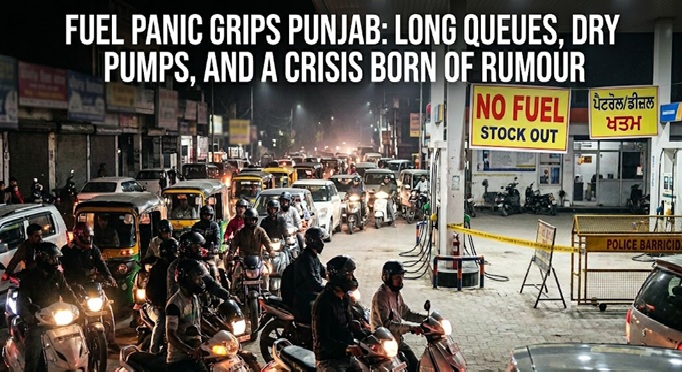
Amritsar / Jalandhar: A wave of panic swept through Punjab’s major cities on Thursday night and into Friday as residents rushed to petrol pumps in large numbers, driven by social media rumours warning of an imminent fuel shortage linked to the escalating conflict in the Middle East. By Friday morning, several pumps in Amritsar and Jalandhar had run dry, police had been deployed at key intersections, and district administrations were in emergency contact with oil companies — all to manage a crisis that, according to the central government, does not actually exist.
Long queues of vehicles were reported across the state — from Guru Ravidas Chowk and BSF Chowk in Jalandhar to pumps throughout Amritsar and Phagwara — stretching late into Thursday night. Motorists described waits of two hours or more. At a fuel station near Constitution Square in Jalandhar, the petrol stock was exhausted entirely, prompting a temporary closure that only deepened public anxiety.
“The closure was due to a slight delay in supply — there is absolutely no need for panic. Stock is on its way.” — Sudarshan Singh, Pump Salesman, Jalandhar
The Trigger: Rumours, Social Media, and a Distant War
The immediate catalyst for the panic is the intensifying military confrontation involving Iran, Israel, and the United States in the Middle East, which has raised global fears about disruptions to oil shipments through the Strait of Hormuz — the narrow waterway through which roughly 20 percent of the world’s oil supply passes. Videos and posts spreading on WhatsApp and other platforms warned that India’s petrol and diesel supplies were running critically low, some falsely claiming that a lockdown was imminent.
Dealers and officials say the rumours were entirely unfounded but proved devastatingly effective. “People began filling their tanks to the brim out of fear,” said Sukhmohan Singh, President of the Petrol Pump Dealers’ Association and a Bharat Petroleum outlet owner in Jalandhar. “This created a completely artificial strain on supplies. The oil companies have more than enough reserves.”
The Administration Responds
In Jalandhar, the situation was reviewed at an emergency meeting involving the Deputy Commissioner and the Police Commissioner, after which a joint appeal was issued urging citizens to disregard the rumours. Sukhmohan Singh confirmed that pump operators and administration were aligned in their messaging: supplies are normal, and panic buying is the sole source of disruption.
Amritsar’s district administration deployed police personnel at multiple pumps by Friday morning, particularly at those operated by Bharat Petroleum and Hindustan Petroleum — whose BPCL and HPCL outlets were the worst affected. Pumps operated by Indian Oil Corporation were reported to be functioning comparatively normally. Officials stated they were in continuous contact with oil company representatives to accelerate resupply.
“India’s energy supply is fully secure and stable. There is no shortage of petrol, diesel, or LPG anywhere in the country. Misinformation and panic-driven narratives are completely unfounded.”— Ministry of Petroleum & Natural Gas, Official Statement, 26 March 2026
Centre Pushes Back: “A Deliberate Misinformation Campaign”
The Ministry of Petroleum and Natural Gas issued a strongly worded statement on Wednesday describing the panic as the result of a “deliberately mischievous, coordinated campaign of misinformation.” The ministry clarified that crude oil supplies for the next 60 days have already been secured from over 41 international suppliers, and that supply disruptions linked to the Strait of Hormuz have been more than compensated for by India’s diversified import strategy. Every Indian refinery is running at over 100 percent utilisation, the ministry noted.
The ministry also warned that misleading videos and posts had falsely portrayed routine administrative orders as emergency measures, and stressed that spreading false information about essential commodities is a punishable offence under Indian law. Citizens were urged to rely only on official channels for information.
Wider Panic: Punjab Is Not Alone
The fuel panic is not limited to Punjab. Similar scenes were reported in Dharwad in Karnataka, and in Haryana’s Fatehabad, where BPCL pumps near the bus stand ran out of fuel by early afternoon on Friday after failing to receive adequate deliveries from the Panipat refinery. In Pune, the Petrol Dealers Association and Indian Oil and Bharat Petroleum both issued separate statements confirming adequate supplies, warning against black-market fuel purchases and urging citizens not to believe social media rumours.
The phenomenon is, in essence, a textbook example of a self-fulfilling panic: the fear of a shortage creates the very conditions — extraordinary demand, emptied stations — that make the shortage appear real, even when underlying supply is stable.

What Residents Should Know
Both the central government and local pump associations have delivered a consistent message: there is no fuel crisis in India. The temporary unavailability at some outlets is entirely the result of demand surges caused by panic buying, not any failure in the supply chain. Resupply is underway at affected stations, and conditions are expected to normalise within hours as panic subsides.
Citizens in Ludhiana, Amritsar, Jalandhar, and across Punjab are advised to fuel their vehicles as they normally would — and to resist the impulse to fill tanks to capacity. Doing so only extends the very queues that people are trying to avoid.
“There is no need for anyone to fill their tank completely. Buy what you need, as you always have. That is all it takes to end this.”— Sukhmohan Singh, President, Petrol Pump Dealers’ Association, Jalandhar
This is a developing story. The Punjab Tribune will continue to update as the situation evolves. Residents with information from local pump operators or administration may contact our bureaus in Amritsar and Jalandhar.


Leave a Reply