

CHANDIGARH – In a landmark ruling that champions the principle of pay parity, the Punjab and Haryana High Court has issued a stern directive to the Punjab Government, ordering the immediate release of pending Dearness Allowance (DA) to all eligible employees and pensioners by June 30.
The Court’s intervention comes after it observed a pattern of “hostile discrimination,” where top-tier officials received timely inflation-linked benefits while thousands of other state employees were left in the lurch.
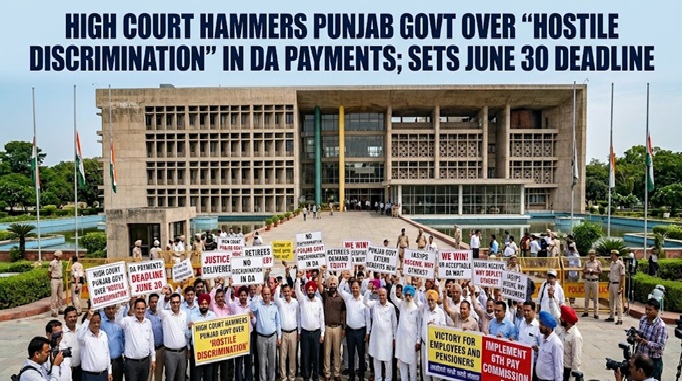
The Crux of the Crisis: A Divided Workforce
The legal battle was sparked by a petition highlighting a stark disparity in how the state treats its workforce. The Court was apprised of a “two-tier” system of disbursement that has emerged within the administration:
-
The Protected Class: IAS, IPS, IFS, and judicial officers have been receiving DA instalments periodically, aligned with the Central Government’s pattern.
-
The Deprived Class: General state employees and pensioners have seen their payments delayed or withheld entirely, despite traditional parity with the Centre.
“Such discrimination cannot be condoned,” the Bench stated, emphasizing that the state cannot pick and choose which categories of public servants deserve protection against inflation.
A Breakdown of the Delays
Traditionally, the Punjab government follows the Central Government’s lead, revising DA twice a year (January 1 and July 1) based on the All India Consumer Price Index. However, the timeline presented to the Court revealed a significant backlog:
| Instalment Due Date | Status of Release |
| January 1, 2023 | Released nearly two years late on Nov 1, 2024 |
| July 1, 2023 | Currently Pending |
| Subsequent 2024 Instalments | Currently Pending |
The petitioners argued that these delays have caused “severe financial detriment” to retirees who rely on these funds to cope with the rising cost of living.
Policy vs. Rights
The Punjab government attempted to defend the delays by categorizing DA increases as a policy decision rather than an absolute right. State counsel argued that the timing of such payments is contingent upon the State’s current financial health.
The Court, however, remained unmoved by the “empty treasury” argument. By setting a hard deadline, the judiciary has signalled that fiscal management cannot be used as a shield to justify “hostile” administrative practices that favour elite cadres over the broader workforce.

What Happens Next?
The State now faces a race against time to mobilize the necessary funds before the June 30 deadline. The legal and financial implications are significant:
-
Compliance: The government must ensure that all arrears and current instalments are credited to bank accounts within the next few weeks.
-
Contempt Risk: Failure to meet the deadline could lead to strict legal consequences when the matter returns to the courtroom.
-
Next Hearing: The Court has scheduled the next follow-up hearing for July 3, where the state must provide a comprehensive compliance report.
For the thousands of pensioners and state workers who have been waiting for over a year, this ruling serves as a vital victory for administrative equity.










Leave a Reply