

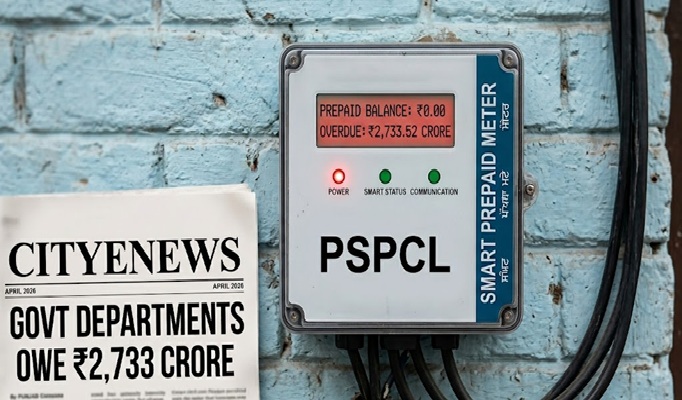
CHANDIGARH – The Punjab State Power Corporation Limited (PSPCL), already grappling with a severe cash crunch, is facing a deepening financial crisis as outstanding dues from state government departments have surged to a staggering ₹2,733.52 crore.
In an aggressive bid to stop the bleeding, the utility is accelerating the installation of smart prepaid meters—a move that effectively puts the government on a “pay-as-you-go” plan.
The “Big Four” Defaulters
Data reveals that the debt is heavily concentrated. Just four departments are responsible for approximately 90% of the total outstanding amount, totalling ₹2,479.65 crore.
| Department | Outstanding Dues (₹ Crore) |
| Water Supply & Sanitation | 1,032.94 |
| Local Government | 936.32 |
| Rural Development & Panchayat | 363.07 |
| Health & Family Welfare | 146.69 |
Other significant defaulters include the Sewerage Board (₹63.02 cr) and School Education (₹31.10 cr). Despite multiple extensions of the “One Time Settlement” (OTS) scheme throughout 2023 and 2024, these departments have remained largely non-compliant.
The Prepaid Ultimatum
To enforce financial discipline, PSPCL has turned to technology. Under the new smart prepaid scheme, government offices must recharge their electricity accounts in advance.
“The system is automated. Once the balance in the account is exhausted, the power supply will be switched off automatically,” confirmed a senior PSPCL official.
The transition is well underway:
-
Target Connections: ~52,000
-
Installed to Date: ~39,000
-
Completion Rate: 75%
Regional Breakdown: Border Zones Hit Hardest
Geographically, the burden is not distributed evenly. The Border Zone leads the state in defaults, followed closely by the West Zone.
-
Border Zone: ₹642.81 crore
-
West Zone: ₹630.88 crore
-
North Zone: ₹422.23 crore
-
South Zone: ₹396.24 crore
-
Central Zone: ₹333.50 crore

A Cycle of Debt
The financial instability is creating a dangerous domino effect. The delay in recovering these dues, coupled with the state’s massive free power subsidy bill, has forced PSPCL to take repeated high-interest loans.
This debt cycle has moved beyond balance sheets and is now impacting livelihoods; employees and retirees are increasingly facing delays in salaries and pensions. Last year, the Punjab State Electricity Board Engineers Association (PSEBEA) took the extraordinary step of appealing to the Regulatory Commission to intervene, citing a threat to public interest.
While the Punjab government continues to offer popular power subsidies, the mounting debt of its own departments suggests a growing disconnect between policy and fiscal reality. For now, PSPCL’s survival may depend entirely on whether those 39,000 smart meters can successfully force the government to pay its own bills.











Leave a Reply