

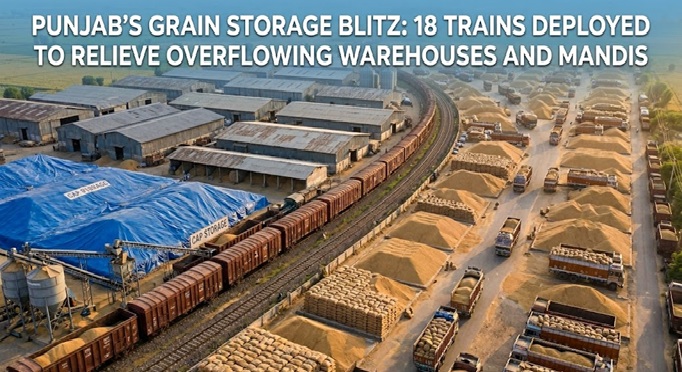
CHANDIGARH – In a high-stakes race against the harvest clock, the Central Government has launched an aggressive “clearance drive” to evacuate aging grain stocks from Punjab’s overflowing warehouses. With the arrival of the new wheat season threatening to paralyze the state’s procurement infrastructure, the Ministry of Railways has dispatched 18 special freight trains to ferry old grain to consuming states across India.
The Storage Math: A State at Breaking Point
The scale of the logistical bottleneck is unprecedented. Punjab currently possesses a total covered storage capacity of 155 Lakh Metric Tonnes (LMT). However, the existing inventory has already breached this limit, creating a “full house” scenario:
-
Paddy Inventory: 139 LMT
-
Existing Wheat Stock: 41 LMT
-
Current Occupancy: 180 LMT
With an additional 130 LMT of new wheat expected to be procured this season, the state is effectively facing a storage deficit of nearly 155 LMT. Without the immediate removal of old stock, the new harvest would be forced to sit in open mandis (grain markets), exposed to the elements and potential spoilage.
Federal Intervention: Exceeding the Request
Union Minister of State for Railways, Ravneet Singh Bittu, confirmed that the Centre is prioritizing Punjab’s evacuation needs. While the state government initially requested 17 trains to manage the overflow, the Centre responded by providing 18 trains—including one additional rake to bolster the effort.
“The priority is to create a vacuum in the warehouses so that the new wheat can be moved from the markets into safe storage immediately,” Bittu stated. He further assured that the Railway Ministry remains on standby to dispatch more trains should the situation demand further acceleration.
Pressure Mounts on State Procurement
Despite the influx of transport rakes, the procurement process on the ground remains a point of contention. Minister Bittu noted that while the “exit door” for old grain is now wide open, the “entry door” for new wheat remains sluggish.
Reports from various districts suggest that slow lifting from the mandis is causing significant distress for farmers, who are often forced to wait days to offload their produce. The Minister urged the Punjab government to capitalize on the newly created storage space and speed up the procurement cycle to clear the backlogs in the grain markets.

The Road Ahead
The success of this season now hinges on a seamless “handshake” between three entities:
-
The Railways: Maintaining the frequency of the 18+ trains.
-
State Agencies: Ensuring rapid labour and transport for “lifting” within 72 hours.
-
FCI: Coordinating the movement of old paddy and wheat to deficit states.
As the peak harvest days approach, all eyes remain on the tracks. For Punjab’s farmers, these 18 trains represent more than just logistics—they are the lifeline that ensures their hard-earned crop has a roof over its head.











Leave a Reply