

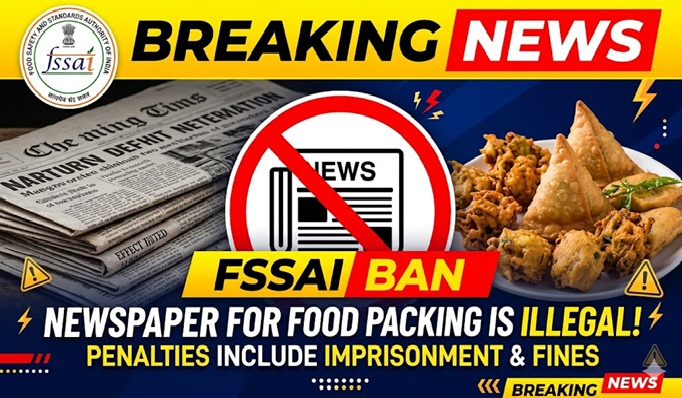
NEW DELHI – The Food Safety and Standards Authority of India (FSSAI) has launched a robust nationwide enforcement drive, signalling a definitive end to the decades-old practice of using newspaper sheets to serve or pack food items. From street-side tea stalls to established eateries, vendors found utilizing newsprint to hold fried snacks like samosas, pakoras, and bhaturas will now face strict legal action.
The move comes as the apex food regulator steps up efforts to eliminate the “invisible” health risks associated with a habit deeply ingrained in India’s street food culture.
The Silent Health Hazard
While newspaper has long been a convenient, low-cost absorbent for oil, the FSSAI emphasizes that the practice is fundamentally dangerous to human health. According to the Food Safety and Standards (Packaging) Regulations, 2018, newsprint is strictly classified as non-food grade material.
The health risks identified by food scientists and health experts are manifold:
-
Chemical Leaching: Printing inks contain toxic chemicals, including solvents, binders, and pigments. When food—especially hot or oily food—comes into contact with the ink, these substances migrate into the meal.
-
Heavy Metal Toxicity: Many printing inks are laden with heavy metals like lead, chromium, and cadmium. Chronic ingestion of these metals, even in small amounts, is linked to severe health complications, including damage to the kidneys, liver, and nervous system.
-
Biological Contamination: Newspapers are handled by numerous people and exposed to various environments before reaching a food stall. The paper often carries dangerous pathogens, dust, and microscopic debris that can cause foodborne illnesses.
-
Vulnerable Populations: Children, pregnant women, and the elderly are at the highest risk, as their systems are less equipped to handle the accumulation of synthetic contaminants and heavy metals over time.
Legal Consequences for Violators
The FSSAI has made it clear that “awareness” is no longer the only strategy; active enforcement is now the priority. Under the Food Safety and Standards Act, 2006, food business operators (FBOs) are legally obligated to use only food-grade packaging.
Violators—ranging from small-scale street vendors to large catering establishments—face several levels of enforcement:
-
Immediate Corrective Notices: Officials are empowered to issue on-the-spot warnings and require an immediate cessation of the practice.
-
Heavy Fines: Monetary penalties can be levied against businesses failing to meet packaging safety standards.
-
Legal Prosecution: In scenarios where the food is deemed “unsafe” due to high levels of contamination, the Act provides for legal proceedings in a court of law.
-
Imprisonment: In severe cases of persistent non-compliance or where a significant public health risk is proven, the law allows for imprisonment.
A Call for Compliance
The FSSAI has urged state-level food safety commissioners to conduct rigorous, regular inspections. However, the regulator also acknowledges that the solution requires a shift in consumer habits.
What Vendors Should Do:
-
Switch to Food-Grade Paper: Use only materials certified as food-grade, such as parchment paper, wax paper, or butter paper, which are specifically designed to be safe for contact with edible items.
-
Adopt Sustainable Alternatives: Shift to eco-friendly packaging options like banana leaves or sal leaves, which are traditional, hygienic, and biodegradable.

What Consumers Should Know:
Consumers play a pivotal role in enforcing this standard. The FSSAI strongly advises the public to refuse any food that is served or wrapped in newspapers and to report vendors who refuse to adopt safer alternatives to their local Food Safety Officer.
As India continues to modernize its culinary infrastructure, the FSSAI’s mandate serves as a critical reminder: Convenience should never come at the cost of public health.













Leave a Reply