

CHANDIGARH — Despite stringent government claims and satellite surveillance, the fields of Punjab have once again begun to blaze. As the wheat harvest gains momentum, the state is witnessing a sharp spike in crop residue burning, pushing air quality in industrial hubs like Mandi Gobindgarh into the “Severe” category.
According to data from the Punjab Pollution Control Board (PPCB), 44 cases of wheat residue burning have been officially registered so far this season. On Tuesday, the Air Quality Index (AQI) in Mandi Gobindgarh hit 350, a staggering 117-point jump from the previous day, placing it in the ‘Severe’ bracket. Other major cities, including Bathinda (155), Amritsar (135), and Patiala (106), remain in the ‘Moderate’ or ‘Yellow’ zone, though experts warn of a decline as harvesting peaks.
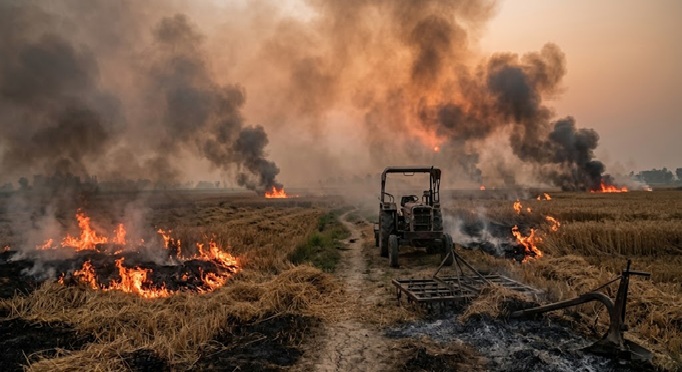
Strict Enforcement: Fines and “Red Entries”
The state administration has intensified its crackdown on violators. In an effort to deter farmers from the traditional “burn to clear” method, the PPCB has already:
-
Imposed Fines: Environmental compensation totalling ₹20,000 has been levied across four cases.
-
Legal Action: An FIR was registered under Section 223 of the Bharatiya Nyaya Sanhita (BNS) for “disobedience to orders duly promulgated by a public servant.”
-
Land Restrictions: “Red Entries” have been marked in the land records of three farmers. This administrative blacklisting ensures the concerned individuals cannot sell or mortgage their land, effectively freezing their primary financial asset.
The 2026 Harvest: Yield and Residue Challenges
This season, wheat was cultivated over approximately 3.4 million hectares (86 lakh acres) in Punjab. While initial estimates projected a record harvest, recent crop-cutting experiments indicate a yield dip of nearly 2 quintals per acre due to unseasonal heat spikes in March.
Even with a slightly lower yield, the state is expected to produce roughly 20.5 million tonnes of straw. The short window between clearing fields and the next sowing cycle remains the primary driver for stubble burning, despite the deployment of 8,000 personnel in the “Parali Protection Force.”

District-Wise Hotspots (Historical Comparison)
Satellite monitoring, which began on April 1 and continues through May 30, shows that traditional hotspots are beginning to see activity. On Monday alone, 14 cases were registered.
| District | 2024 (Full Season) | 2025 (Full Season) | 2026 (Early Cases) |
| Amritsar | 1,015 | 1,102 | 2 |
| Gurdaspur | 1,335 | 856 | 3 |
| Ludhiana | 841 | 640 | 2 |
| Ferozepur | 919 | 743 | 5 |
| SBS Nagar | – | – | 8 |
Expert Note: “The toxic air is a direct consequence of the rush to clear fields. While we are educating farmers on ex-situ management (using straw for biomass) and in-situ methods (Happy Seeders), the economic pressure of the next sowing cycle often outweighs the fear of penalties,” said a senior official from the PPCB.
With the harvest expected to peak over the next ten days, the Punjab government faces a critical test in balancing agricultural productivity with environmental health.










Leave a Reply