

Punjab & Haryana High Court directs Zirakpur Municipal Council to remove billboard structures in their entirety from prohibited zones; compliance report with photographs due May 8.
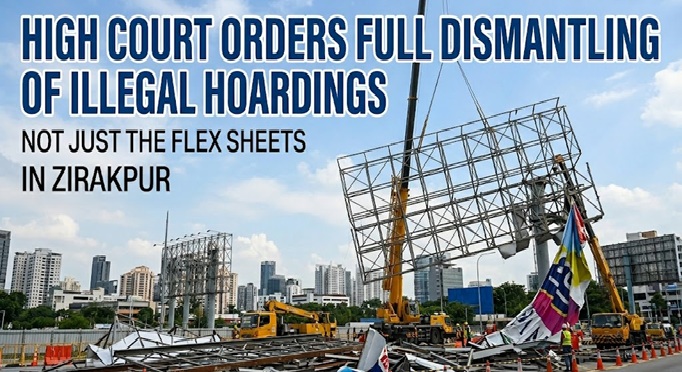
The next drive across Zirakpur’s traffic-choked roads may finally target not just the congestion below, but the clutter above. The Punjab and Haryana High Court has ordered a comprehensive removal of all illegally installed billboards, unipoles, bipoles and gantries — making it unequivocally clear that merely stripping off flex sheets will not suffice if the skeletal metal structures continue to stand.
The direction came after the Court examined Zirakpur Municipal Council’s own reply and photographs. The Bench, headed by Chief Justice Sheel Nagu, observed that the submitted material revealed advertising structures remained widely installed in clearly prohibited areas.
PROHIBITED ZONES NAMED
The prohibited locations identified by the Court included rooftops of buildings, residential zones, heritage sites and monuments, as well as transportation hubs such as airports, railway terminals, bus stands and truck terminals — even extending to crematoriums and burial grounds.
The Bench observed that the material on record showed flex banners had been removed in some cases, but the metallic frameworks supporting them remained fully intact. This partial compliance was found inadequate and contrary to the spirit of the law.
COURT’S DIRECTION — VERBATIM
“The Executive Officer of Municipal Council, Zirakpur, is directed to ensure removal of all Bill-boards, Unipoles, Bipoles and Gantaries installed unlawfully in areas where they are not permitted and file a compliance report along with photographs before the next date of hearing.”
A STRATEGIC GATEWAY UNDER PRESSURE
Strategically located at the junction of key arterial routes, Zirakpur serves as a crucial gateway linking Punjab, Haryana and Himachal Pradesh, with heavy traffic flowing daily towards Chandigarh, Panchkula, Ambala, Patiala and Kalka. The National Highways and flyovers passing through the town carry a dense mix of local and inter-state vehicular movement.
In this backdrop, the unchecked proliferation of illegal hoardings along high-speed corridors assumes added significance, directly impacting commuter safety on one of the region’s busiest transit belts. Any obstruction or visual distraction along these stretches poses a demonstrably heightened hazard.
STRUCTURAL REMOVAL, NOT COSMETIC FIXES
The significance of the High Court’s directions lies in their scope: authorities are required to achieve complete dismantling — not partial measures that leave behind structural remnants. Earlier drives had often resulted in the removal of banner cloth while leaving behind poles, frames and metal supports, a practice the Court has now explicitly ruled out.
The matter will next be heard on May 8, when the Court will review whether the mandated drive has translated into actual, documentable removal on the ground. Photographic evidence will be required to accompany the compliance report submitted by the Executive Officer.
THE PETITION: SAFETY ALARM FROM A CITIZEN
The matter was brought to the High Court’s notice after petitioner Arjun Shukla filed a public interest petition and appeared before the Bench in person. He raised alarm over the rampant proliferation of illegal and unauthorised hoardings in Zirakpur and along the National Highways connecting it to Banur, Patiala, Ambala and Kalka, flagging them as a serious threat to public safety and a violation of established legal norms.
Shukla submitted that hoardings had come up at non-designated sites — including along major highway stretches and the Zirakpur flyover — often exceeding permissible dimensions and encroaching upon the Right of Way (ROW). These structures, he argued, distracted motorists and significantly increased the risk of accidents.
Referring to the gravity of the issue, the petitioner pointed to recent incidents including the collapse of a hoarding in Zirakpur that damaged multiple vehicles. The plea also drew attention to relevant circulars and regulatory frameworks governing outdoor advertisements, asserting that violations continued unchecked despite clear guidelines being in place.
The Union of India was represented before the Bench by Additional Solicitor-General Satya Pal Jain. With the May 8 hearing now set as the compliance deadline, all eyes will be on whether the Municipal Council of Zirakpur rises to the occasion — or whether the skyline above the city’s roads remains as cluttered as the streets below.

KEY FACTS AT A GLANCE
- Bench headed by Chief Justice Sheel Nagu passed the order after examining Municipal Council photographs
- Prohibited zones include rooftops, residential areas, heritage sites, transport hubs and crematoriums
- Metal framework was found intact even where flex sheets had been removed
- Petition filed in public interest by Arjun Shukla, who appeared in person
- A recent hoarding collapse in Zirakpur damaged multiple vehicles, cited in the plea
- Union of India represented by Additional Solicitor-General Satya Pal Jain
- Compliance report with photographs due before May 8 hearing
cityenews.com | Covering Punjab & the Tricity Region | © 2025 City E News. All rights reserved.








Leave a Reply