

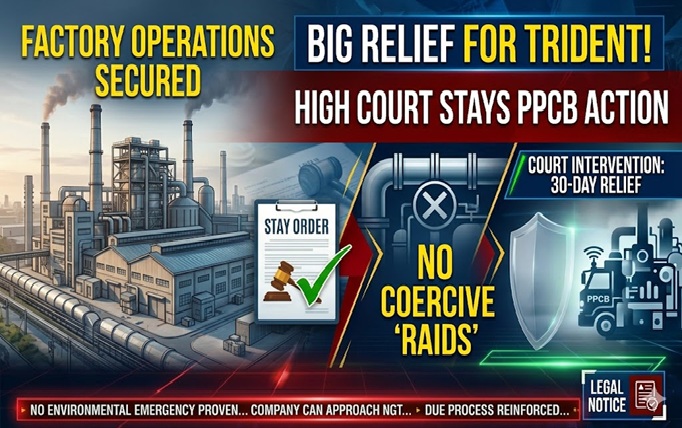
CHANDIGARH – In a significant legal victory for the Trident Group, the Punjab and Haryana High Court has stayed the coercive actions initiated by the Punjab Pollution Control Board (PPCB). The court ruled that the regulatory body cannot bypass due process unless a “grave environmental emergency” is proven, granting the company a 30-day window to address any alleged deficiencies.
The ruling comes amidst a heated political backdrop involving Trident’s founder and Rajya Sabha MP, Rajinder Gupta, who recently defected from the Aam Aadmi Party (AAP) to the Bharatiya Janata Party (BJP).
Procedural Fairness Over Coercion
The High Court emphasized that regulatory bodies must provide a “reasonable opportunity” for industries to rectify shortcomings before taking drastic measures.
“Unless a grave environmental emergency is proven, it is mandatory to provide the company with a fair chance to address and rectify any deficiencies,” the Court stated.
As part of the relief, the Court has:
-
Halted all coercive actions for a period of 30 days.
-
Mandated a response window allowing Trident to reply to the PPCB’s findings.
-
Granted liberty for the company to approach the National Green Tribunal (NGT) if further legal intervention is required.
Allegations of Political Vendetta
The legal battle has quickly taken on a political hue. Counsel for the Trident Group argued that the PPCB’s sudden interest in the facility was an act of political retaliation. The company pointed to a massive 30-member inspection team that arrived at the premises at 7:30 PM on April 30, characterizing the move as a “raid” intended to exert pressure rather than a routine inquiry.
Trident’s legal team submitted that the company held valid environmental clearances through mid-April and had maintained a record of satisfactory compliance in previous checks. They asserted that the timing of the PPCB’s aggressive stance coincided directly with Mr. Gupta’s shift in political allegiance.
PPCB Denies “Raid” Claims
The Punjab Pollution Control Board has dismissed the allegations of bias, maintaining that the exercise was strictly professional. The Board objected to the company’s use of the term “raid,” clarifying that the visit was a routine inspection under its standard operational protocol.
The PPCB further noted that hundreds of similar inspections have been conducted across large industrial units in recent months to ensure environmental standards are upheld, regardless of ownership.

What Lies Ahead
With the 30-day stay in place, the ball is now in Trident’s court to provide a technical rebuttal to the Board’s findings. If the PPCB remains unsatisfied after the grace period, the dispute is expected to move to the National Green Tribunal (NGT), where the focus will shift from procedural conduct to the specific technical merits of the company’s environmental compliance.










Leave a Reply