

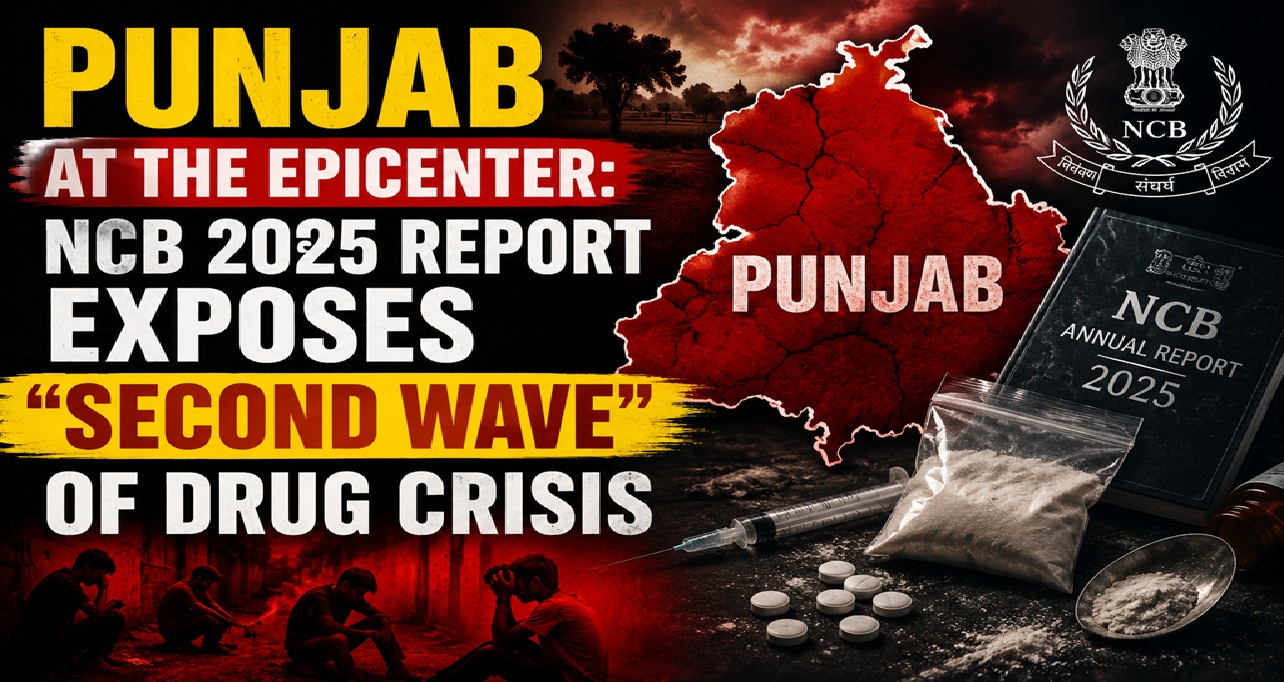
NEW DELHI — The Narcotics Control Bureau (NCB) has officially categorized the rising abuse of codeine-based cough syrups as a “dangerous second wave” of the drug crisis in India, with Punjab emerging as the primary hotspot. The findings were detailed in the NCB Annual Report 2025, released by Union Home Minister Amit Shah during the 10th Apex-Level Meeting of the Narco-Coordination Centre (NCORD) on June 26, 2026.
The “Second Wave”: Pharmaceutical Diversion
The report highlights a disturbing trend of pharmaceutical misuse. In 2025, authorities confiscated over 8.95 lakh bottles of codeine-based cough syrup in Punjab—the highest figure of any state in the nation. Experts note that this surge in diverted pharmaceuticals, including drugs like Tramadol and Buprenorphine, signals a shift in the addiction landscape, moving beyond traditional plant-based narcotics to synthetic and prescription-based substances that are often harder to track and regulate.
Drone-Borne Trafficking: A 100-Fold Increase
Security agencies have raised alarms over the evolving tactical methods of trans-border syndicates. The India-Pakistan border, particularly along the Punjab sector, has become a high-tech battleground for drug smuggling.
-
Scale of the Threat: In 2025 alone, there were 305 recorded cases of drone-based smuggling attempts. Of these, 289 (97.7%) were attributed to the Punjab sector.
-
Technological Escalation: The frequency of drone incidents has skyrocketed, with a nearly 100-fold increase recorded over the last five years (rising from just 3 cases in 2021).
-
Strategic Hub: The report confirms that Punjab remains the primary landing zone for drugs flowing through the “Golden Crescent” route, which connects Afghanistan, Pakistan, and Iran.
National Security Implications
Home Minister Amit Shah emphasized that the drug trade is no longer just a law-and-order issue but a critical threat to India’s internal security and the future of its youth. With heroin seizures in Punjab totalling 2,085.55 kg—accounting for 58% of the country’s total 3,567 kg seizure—the state remains the focal point of the government’s anti-narcotics strategy.
The Roadmap: “Detect, Disrupt, and Destroy”
In conjunction with the report, the government unveiled the “Vision Document on Drug Control (2026–2029).” This strategic roadmap shifts the focus from chasing low-level street peddlers to dismantling entire transnational networks.
-
Legislative Reform: The Ministry of Finance and the Department of Revenue are currently “relooking” at the NDPS Act to close regulatory loopholes and expedite convictions.
-
Aggressive Enforcement: The new mandate calls for the ruthless pursuit of drug kingpins, including financial investigations to freeze the assets of syndicates and the use of AI-enabled profiling to track trafficking routes.
-
Whole-of-Government Approach: The strategy integrates 44 central ministries, state agencies, and civil society to tackle the issue through a four-pillar approach: Enforcement, Precursor/Synthetic Drug Control, Demand Reduction, and Capacity Building.

As the government enters this decisive three-year window, the message is clear: the fight against narcotics has reached a critical juncture where the state’s technological and intelligence-led capabilities will determine whether the “second wave” of addiction can be effectively contained.










Leave a Reply