

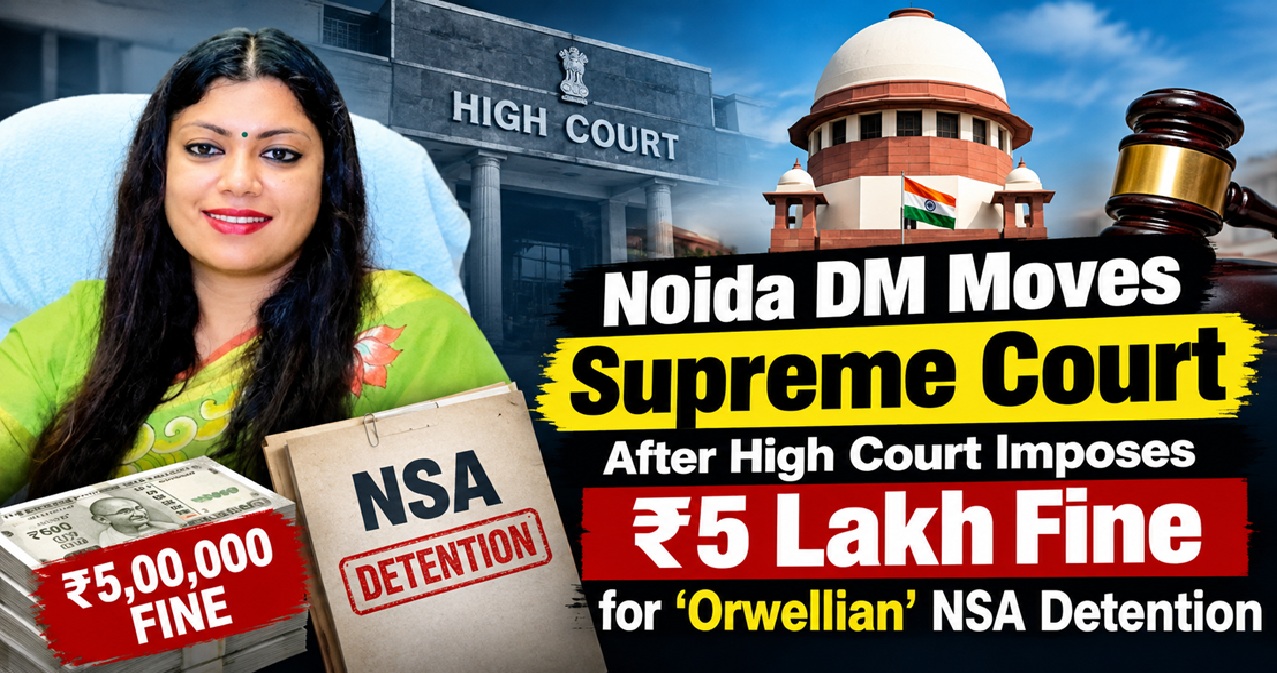
NEW DELHI — Gautam Buddha Nagar District Magistrate Medha Roopam has approached the Supreme Court challenging an Allahabad High Court verdict that ordered a ₹5 lakh deduction from the salaries of top administrative officials for the illegal detention of a student activist under the National Security Act (NSA).
The petition comes days after a Division Bench of the High Court, comprising Justices Atul Sreedharan and Achal Sachdev, quashed the detention of Akriti Chaudhary, a 25-year-old Delhi University graduate, warning that unchecked bureaucratic overreach risks turning Uttar Pradesh into an “Orwellian dystopia.”
The Case and the Arrest
Chaudhary, a history graduate from Delhi University, was arrested following a demonstration by factory workers demanding wage hikes in Noida’s industrial hub. On May 13, the Gautam Buddha Nagar district administration invoked the stringent National Security Act against Chaudhary and social activist Satya Verma, alleging their activities posed a threat to public order.
Chaudhary subsequently moved the High Court via a habeas corpus petition, arguing that her detention was an abuse of executive power aimed at stifling peaceful civic advocacy.
A Scathing Judicial Rebuke
In a strongly worded judgment quashing the detention order, the High Court held that the case presented by law enforcement was essentially “fabricated” to justify holding the activist without trial.
The Court pointed to severe procedural irregularities, noting that the statutory notice issued under Section 130 of the Bharatiya Nagarik Suraksha Sanhita (BNSS) had been backdated. According to the Bench, the General Diary entry number cited on the document was recorded only after Chaudhary was already in custody, rendering the paperwork an ex post facto sham.
After reviewing the police dossier—which included seized mobile phone chats, footage, and witness statements—the Bench concluded there was no evidence that Chaudhary had incited violence or caused property damage during the protest.
Issuing a sharp warning to the state apparatus, the Bench observed that officials must remember their constitutional mandate:
“The civil service owes its allegiance to the Constitution, not to the political executive. In a democracy, the people are the masters, and the officers are their servants. If such authoritarian conduct by an unchecked bureaucracy continues, Uttar Pradesh could transform into an Orwellian dystopia.”
Unprecedented Personal Penalties
Rather than directing the state exchequer to disburse compensation, the High Court ordered that ₹5 lakh be paid directly to Chaudhary and recovered from the monthly salaries of District Magistrate Medha Roopam and the concerned police officials, including the local Station House Officer (SHO).
The Court further mandated that strictures reflecting its “extreme displeasure” be permanently entered into the confidential service books of the errant officers.

The Plea Before the Apex Court
In her Special Leave Petition before the Supreme Court, the District Magistrate has sought an immediate stay on the salary recovery and the expungement of the adverse remarks.
The appeal contends that a District Magistrate acts in a quasi-judicial capacity when evaluating preventive detention dossiers submitted by the police and intelligence wings. It argues that personal financial penalties and career-damaging strictures breach established protections for officers performing statutory duties, setting a disruptive precedent for executive governance.
The Supreme Court is expected to take up the matter in the coming days, with the proceedings set to test the limits of judicial intervention in executive accountability and the legality of holding individual civil servants financially liable for misuse of preventive detention laws.










Leave a Reply