

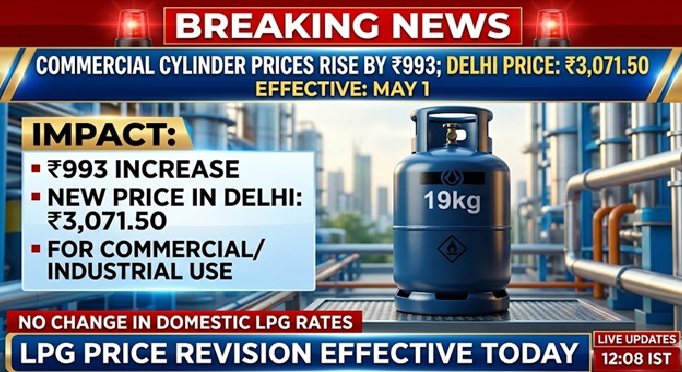
NEW DELHI — In a move that signals a sharp shift in energy pricing for the industrial sector, state-run oil marketing companies (OMCs) have announced a massive hike in the price of commercial Liquefied Petroleum Gas (LPG). Effective today, May 1, the price of a 19-kilogram commercial cylinder has increased by ₹993, bringing the retail price in the national capital to a staggering ₹3,071.50.
While the hike marks one of the steepest single-day increases in recent history, the Indian Oil Corporation (IOC) emphasized that the move is part of a “balanced approach” designed to align with volatile global energy benchmarks while shielding the average Indian household from inflation.
A Strategy of “Selective Adjustment”
The price revision is highly surgical. According to data provided by IOC, approximately 80% of all petroleum products—including those most critical to the common man—remain untouched.
What stays the same:
-
Domestic LPG: Prices for 14.2-kg cylinders remain stable for nearly 330 million consumers.
-
Petrol & Diesel: Retail rates at the pump remain unchanged for the general public, who account for 90% of total fuel consumption.
-
Kerosene: Rates for the Public Distribution System (PDS) have not been revised.
-
Domestic Aviation Fuel: Prices for domestic airlines remain frozen to keep air travel affordable.
What is getting more expensive:
-
Commercial LPG: Impacting hotels, restaurants, and small businesses (representing less than 1% of total consumption).
-
Bulk Diesel: Large-scale industrial buyers will face higher costs.
-
International ATF: Fuel prices for international carriers have been hiked to match global market trends.
The Global Context: Why Now?
The sudden spike is a direct reaction to the rising costs of imports. State-run oil companies noted that while they are absorbing the brunt of international price volatility for the public, industrial sectors must align with global benchmarks to maintain economic stability.
| City | New Commercial Price (19kg) | Previous Price |
| Delhi | ₹3,071.50 | ₹2,078.50 |
| Mumbai | ₹3,024.00 | ₹2,031.00 |
| Kolkata | ₹3,189.00 | ₹2,196.00 |
| Chennai | ₹3,235.50 | ₹2,242.50 |

Impact on the Hospitality Sector
Industry experts warn that while the government has successfully “firewalled” the domestic kitchen, the ripple effect of a ₹993 hike will be felt elsewhere. Restaurants and catering services, which rely exclusively on 19-kg cylinders, may be forced to pass these costs onto consumers through higher menu prices.
“By keeping 80% of products stable, the OMCs are attempting to curb mass inflation,” said a senior energy analyst. “However, the 16% of products seeing a hike—primarily industrial fuels—represents the cost of doing business in a high-priced global oil market.”
As of this morning, four percent of petroleum products actually saw a marginal price decrease, reflecting the nuanced, data-driven approach OMCs are currently taking to navigate the current global energy crisis.










Leave a Reply