

TIANJIN — In what global intelligence agencies are calling the most significant security failure in modern history, China’s National Supercomputing Center (NSCC) in Tianjin has been hollowed out by a persistent cyber intrusion. An estimated 10 petabytes of classified military and aerospace data—including the “crown jewels” of China’s missile and fighter jet programs—is now being liquidated on the Dark Web.
The breach, which reportedly spanned six months, has sent shockwaves through Beijing, leading to a frantic internal investigation and the reported dismissal of several high-ranking defence officials.
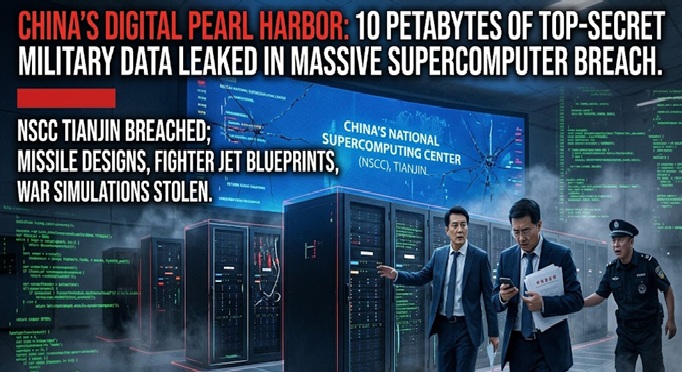
The “Low and Slow” Heist
Unlike the high-speed “smash and grab” attacks typically associated with state-sponsored hacking, the perpetrator—operating under the handle “Flaming China”—employed a strategy of extreme patience.
According to cybersecurity analysts, the attacker bypassed the NSCC’s perimeter via a compromised VPN entry point. Once inside, they utilized a distributed botnet to exfiltrate data in tiny, fragmented packets. By keeping the outgoing traffic volume below detection thresholds, the hacker successfully evaded sophisticated intrusion detection systems for half a year.
“This wasn’t a failure of encryption; it was a failure of architecture,” says one senior security researcher. “Once the VPN was compromised, the internal network lacked the ‘zero-trust’ segmentation necessary to stop a lateral crawl through the most sensitive servers in the country.”
A Treasure Trove of Classified Intelligence
The scale of the theft is staggering. 10 petabytes is equivalent to roughly 10,000 terabytes of data. Verified samples appearing on Telegram channels and encrypted forums indicate the cache includes:
-
Aerospace & Missiles: Detailed schematics and structural blueprints for hypersonic missile systems and next-generation fighter jets, including the J-20 stealth platform.
-
War Simulations: Years of proprietary data on “Red vs. Blue” war games, specifically simulations involving strikes on U.S. aircraft carrier groups and HIMARS batteries.
-
Nuclear & Bioinformatics: Sensitive research into fusion energy and genomic data linked to state-run biological research labs.
-
Institutional Access: Internal directories and login credentials for thousands of researchers at the Aviation Industry Corporation of China (AVIC).

Turmoil in the Dark Market
The stolen data has surfaced on a Telegram channel run by “Flaming China,” where the hacker is offering “data packs” categorized by military branch and research sector. While some smaller samples are being sold for several thousand dollars in cryptocurrency to prove authenticity, the price for the full dataset is reportedly in the tens of millions.
Security experts warn that the acquisition of this data by rival intelligence agencies could effectively set back Chinese military development by a decade, as it reveals not only the capabilities of their current weapons but also the specific physics and vulnerabilities behind them.
Strategic Implications
As of April 2026, the NSCC Tianjin facility remains under a total security lockdown. While the Chinese government has not officially commented on the total volume of the loss, the internal fallout is evident.
For the global community, the breach serves as a stark reminder: even the world’s most powerful supercomputers—designed to simulate the future of warfare—are only as secure as the single VPN login used to access them.
The NSCC Tianjin breach is no longer just a data leak; it is a fundamental shift in the global balance of power.














Leave a Reply