

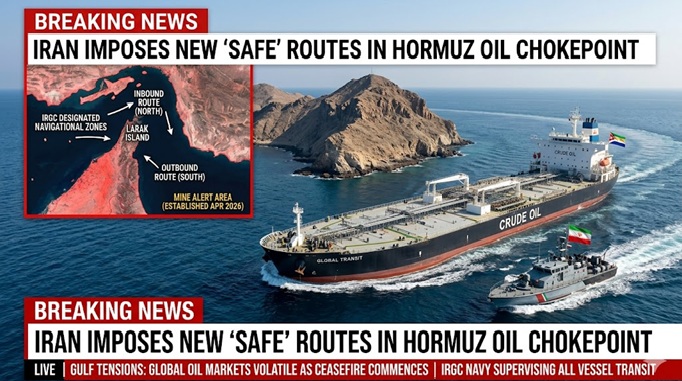
TEHRAN / DUBAI – In a move that has sent ripples through global energy markets and maritime security agencies, the Navy of Iran’s Revolutionary Guard Corps (IRGC) has officially designated new, mandatory transit routes for all vessels passing through the Strait of Hormuz.
The announcement comes as part of a high-stakes, two-week temporary ceasefire, aimed at de-escalating tensions while addressing a growing “maritime mine alert” that has paralyzed the region’s waterways.
The New Navigation Protocol
Citing maritime safety as the “paramount priority,” the IRGC Navy issued a directive effectively scrap the traditional international shipping lanes in favour of a strictly monitored corridor around Larak Island.
The new transit rules are split into two distinct paths:
-
The Entry Corridor: Vessels arriving from the Sea of Oman must now hug the northern side of Larak Island to enter the Persian Gulf.
-
The Exit Corridor: Ships departing the Gulf toward international waters are required to navigate along the southern side of Larak Island.
“All ship movements will take place under the strict supervision of the IRGC Navy,” the statement read, marking a significant shift in how international traffic is managed in the world’s most vital choke point.
A Fragile Reopening: The Ceasefire Context
The decision to reopen the Strait follows a gruelling period of regional instability. Under the terms of a 14-day ceasefire agreement, Iran agreed to clear or bypass hazardous areas to allow for the passage of stranded cargo.
However, the “maritime mine alert” remains in effect. Experts suggest that the new routes are designed to navigate around specific “danger zones” where naval mines were reportedly deployed during the height of recent hostilities.
Global Economic Stakes
The Strait of Hormuz is widely considered the world’s most important oil artery. With approximately 20% of the global oil supply passing through this narrow passage, any disruption carries the weight of a global economic crisis.
| Key Metric | Impact |
| Global Oil Volume | ~21 Million barrels per day |
| LNG Impact | Primary route for Qatari Liquefied Natural Gas |
| Security Status | Temporary 14-day window; IRGC Supervised |
While the reopening has provided a brief sigh of relief for oil markets, the “strict supervision” requirement by the IRGC has raised concerns among Western analysts. Many view this not just as a safety measure, but as a strategic consolidation of Iranian control over the waterway.

What’s Next for Global Trade?
International shipping companies are now faced with a difficult choice: comply with the IRGC’s new unilateral routing or continue to avoid the region at a massive fuel and insurance cost.
As the two-week clock begins to tick, the eyes of the world remain fixed on Larak Island. Whether this move facilitates long-term stability or serves as a precursor to further friction depends entirely on how the supervision is enforced and whether the mine threat can be permanently neutralized.
“The objective is safe and uninterrupted passage,” Iran maintains. Whether the international community agrees with the method remains to be seen.













Leave a Reply