

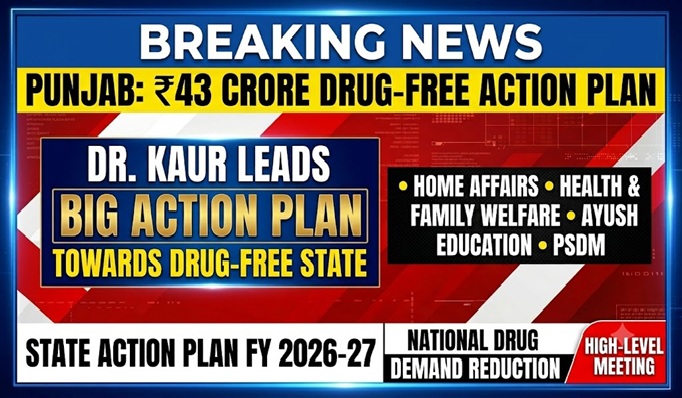
CHANDIGARH — In a major push to combat the state’s drug crisis, the Punjab government has announced a comprehensive State Action Plan (SAP) for the 2026-27 fiscal year. Spearheaded by Dr. Baljit Kaur, Minister for Social Security, Women and Child Development, the strategy aims to transition from traditional enforcement to a multi-dimensional, community-led “people’s movement.”
The announcement follows a high-level meeting at Punjab Bhawan, where senior officials from across the administration—including the departments of Health, Home Affairs, Education, and the Punjab Skill Development Mission—gathered to finalize the blueprint under the National Action Plan for Drug Demand Reduction (NAPDDR).
A Holistic Strategy
Addressing the state’s multi-sectoral approach, Dr. Baljit Kaur emphasized that the government’s vision extends beyond targeting drug peddlers. “Our focus is shifting toward a result-oriented ecosystem that prioritizes prevention, early identification, and the dignified reintegration of affected individuals into society,” the Minister stated.
The proposed Rs 42.95 crore budget for 2026-27 will be deployed across several critical pillars:
-
Preventive Education: Scaling up awareness drives in schools and colleges, integrated with life-skills training to foster resilience among the youth.
-
Capacity Building: Specialized training programs for “frontline workers”—including teachers, health workers, and police officers—to improve their ability to detect and intervene in drug-related cases early.
-
Rehabilitation & Mainstreaming: Boosting the capacity of de-addiction centres while adding a new focus on vocational training. By pairing medical treatment with skill development and employment opportunities, the government aims to ensure long-term stability for recovering individuals.
-
Community Engagement: Mobilizing local communities through sports, cultural activities, and increased youth participation to provide positive outlets that keep the younger generation away from substance abuse.
Commitment to Vulnerable Groups
During the session, the Minister also reviewed the progress of the National Action Plan for Senior Citizens. Reaffirming the government’s commitment to the elderly, she noted that the welfare of senior citizens is a “moral duty.” The state is integrating senior welfare into its broader social security framework to ensure that the elderly—a vital social foundation—receive adequate healthcare, protection, and respect.
A Call for Cross-Departmental Synergy
Dr. Baljit Kaur issued a clear directive to all involved departments to submit their specific budgetary requirements and implementation timelines immediately. The goal is to move past bureaucratic silos and create a unified, rapid-response mechanism.
“Winning this war is not a task for the government alone; it requires every section of society,” Dr. Kaur said. “Our ultimate objective is to provide a clean, healthy, and prosperous future for the youth of Punjab.”
The meeting saw participation from high-ranking officials, including Secretary of Social Security, Women and Child Development, Gurkirat Kirpal Singh (IAS), Director Dr. Shena Agarwal (IAS), Special Secretary Keshav Hingonia (IAS), and Mission Director of the Punjab Skill Development Mission, Amrita Singh (IAS).

With the formalization of this plan, the state government signals a firm intent to institutionalize its fight against drugs, betting on a combination of technology-backed awareness and tangible, skill-based rehabilitation to yield long-term results.











Leave a Reply