

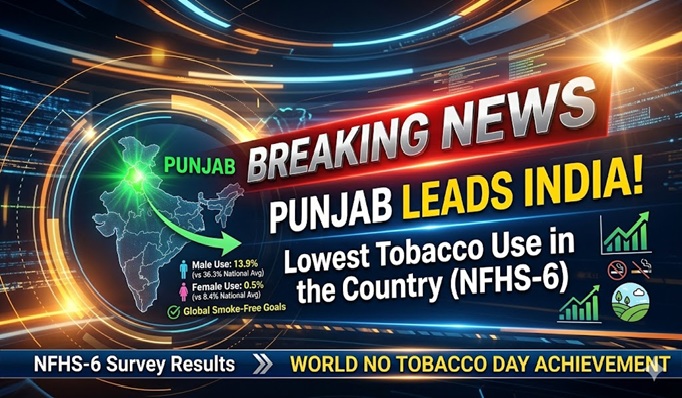
CHANDIGARH – In a landmark achievement for public health, Punjab has officially emerged as the state with the lowest prevalence of tobacco use in India. Data released in the National Family Health Survey 2023-24 (NFHS-6) confirms the state’s exemplary performance, positioning it as the national leader in tobacco control and a blueprint for global smoke-free initiatives.
A Striking Statistical Gap
The NFHS-6 findings, which reflect comprehensive fieldwork conducted between March 2024 and October 2024, reveal a stark contrast between Punjab and the rest of the country:
-
Male Tobacco Use: At just 13.9%, tobacco consumption among men aged 15 and older in Punjab is less than half the national average of 36.3%.
-
Female Tobacco Use: The prevalence among women aged 15 and older stands at a nominal 0.5%, vastly lower than the national average of 8.4%.
These figures are the result of a rigorous sampling process covering 19,616 households, 20,135 women, and 3,160 men across the state.
The “Zero-Tolerance” Strategy
Punjab Health and Family Welfare Minister Dr. Balbir Singh attributed this historic success to a sustained, multi-pronged framework aimed at curbing addiction and protecting the youth.
“This milestone is a direct result of our unwavering commitment to creating a healthy and drug-free state,” said Dr. Singh. “We have adopted a strict zero-tolerance approach toward violations, backed by a robust clinical and community-based support system.”
Key pillars of this state-wide strategy include:
-
Legislative Enforcement: During the 2025-26 fiscal year alone, authorities issued 22,054 challans under the Cigarettes and Other Tobacco Products Act (COTPA), 2003.
-
Accessible Cessation Services: Specialized Tobacco Cessation Centres are now fully functional in every district, providing institutionalized clinical treatment, counselling, and psychological support.
-
Grassroots Mobilization: Over 800 villages have officially declared themselves “tobacco-free,” fostering local partnerships that act as a first line of defence against addiction.
-
Educational Protection: In adherence to National Tobacco-Free Educational Institutions (TOEFI) guidelines, 98.6% of schools across the state are now designated tobacco-free zones, shielding the next generation from early nicotine exposure.

A Vision for the Future
By aligning its health policies with World Health Organization (WHO) protocols, Punjab has effectively transformed the anti-tobacco campaign from a government directive into a massive public movement.
Looking ahead, the Punjab government intends to intensify these efforts. Through the expansion of public awareness campaigns and the continued strengthening of community networks, the state aims to maintain its leading position and champion a healthier, more vibrant, and entirely tobacco-free society.









Leave a Reply