

LEH – In a move set to fundamentally reshape the governance and geography of the Trans-Himalayan region, the Union Territory of Ladakh has officially notified the creation of five new districts. The announcement, approved by Lieutenant Governor Vinai Kumar Saxena on April 27, 2026, marks the most significant administrative overhaul since the region’s transition to a Union Territory in 2019.
With this notification, Ladakh’s district count rises from two to seven, fulfilling a decades-long demand for administrative decentralization in one of the world’s most challenging terrains.
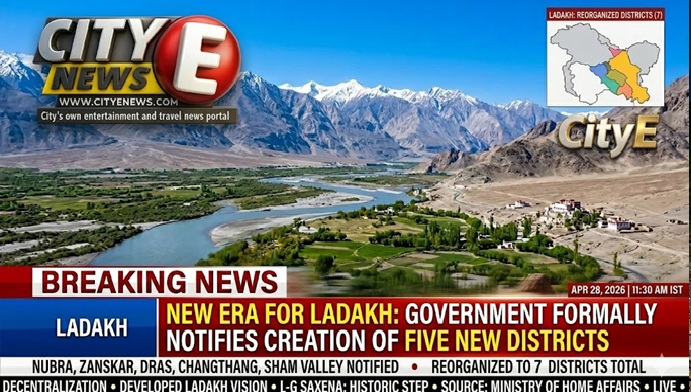
The New Map of Ladakh
The reorganization strategically divides the vast, high-altitude desert into smaller, more manageable administrative units. The new districts have been carved out of the existing Leh and Kargil districts to bring the “Sarkar” (government) closer to the “Sarhad” (border).
From Leh District:
-
Nubra (HQ: Diskit): A strategic valley bordering the Siachen Glacier, vital for both defence and tourism.
-
Sham (HQ: Khaltsi): Often called the “Apricot Hub,” this region covers the lower Ladakh belt.
-
Changthang (HQ: Nyoma): The high-altitude plateau home to the nomadic Changpa tribes and the world-famous Pashmina industry.
From Kargil District:
-
Zanskar (HQ: Padum): A region that remains snowbound for nearly half the year, Zanskar has long sought autonomy from Kargil.
-
Dras (HQ: Dras-Ranbirpura): Known as the second coldest inhabited place on earth, this gateway to Ladakh is a critical strategic point.
A “New Era” of Inclusive Growth
Lieutenant Governor Vinai Kumar Saxena hailed the decision as a cornerstone of Prime Minister Narendra Modi’s vision for a “Viksit Ladakh” (Developed Ladakh).
“This step marks the beginning of a new era. It is not just about drawing lines on a map; it is about bringing the administration to the doorsteps of the people in the remotest corners of the country,” the LG stated.
The move is expected to alleviate the hardships of residents who previously had to travel several days across high mountain passes—such as Khardung La or Penzila—just to access basic district-level government services.
Strategic and Economic Implications
Beyond administrative convenience, the creation of these districts is expected to trigger a wave of development:
-
Infrastructure: Dedicated district budgets will lead to the construction of new secretariats, hospitals, and educational institutions.
-
Employment: The establishment of five new District Magistrate (DM) and Senior Superintendent of Police (SSP) offices, along with subordinate departments, will create significant local job opportunities.
-
Governance: Direct oversight of border development projects will enhance national security and rural stability in sensitive areas like Nyoma and Nubra.
Comparison: Old vs. New Administrative Structure
| Feature | Pre-April 2026 | Post-April 2026 |
| Total Districts | 2 (Leh, Kargil) | 7 |
| Administrative Hubs | Centralized in 2 towns | Decentralized across 7 towns |
| Travel Distance | Often 200km+ to reach HQ | Significantly reduced |
| Local Representation | Broad/Regional | Specific/Community-focused |

Local Reception
The news has sparked celebrations across the plateau. BJP leaders and local representatives in the newly formed districts welcomed the move, calling it a “historic victory” for the people of Zanskar, Dras, and the nomadic communities of Changthang.
As the Union Territory prepares for this transition, officials noted that the immediate focus will now shift to the deployment of personnel and the phased rollout of infrastructure to ensure these new headquarters are fully functional by the next winter season.








Leave a Reply