

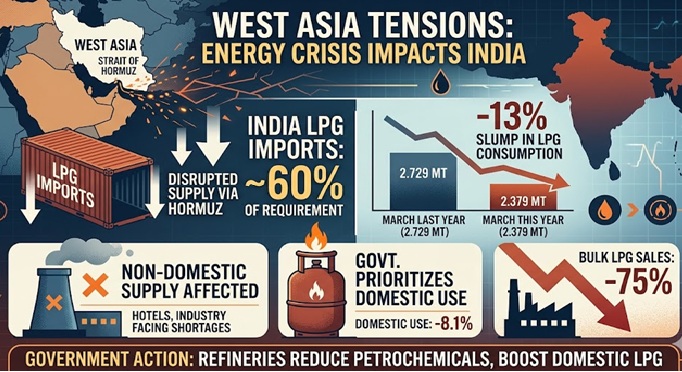
NEW DELHI – The escalating geopolitical volatility in West Asia has sent shockwaves through India’s energy sector, resulting in a sharp 13% decline in Liquefied Petroleum Gas (LPG) consumption for the month of March. Data reveals that total consumption fell to 2.379 million tonnes, down from 2.729 million tonnes during the same period last year, as supply chain disruptions at the Strait of Hormuz begin to bite.
The Strait of Hormuz Bottleneck
India’s energy security remains precariously tied to the stability of West Asian maritime routes. With the country importing approximately 60% of its LPG requirements, the Strait of Hormuz serves as a critical artery for shipments.
Ongoing “war-like conditions” have severely hampered arrivals from major suppliers, including Saudi Arabia and the United Arab Emirates. This logistical stranglehold has forced the Indian government into an aggressive supply-management mode, prioritizing residential “hearth and home” over industrial growth.
Consumption Breakdown: A Sector in Retreat
The impact of the shortage has not been felt equally across sectors. While the government has attempted to shield households, the data tells a story of significant contraction:
-
Non-Domestic (Commercial): Usage plummeted by 48%, as gas was diverted away from hotels and small businesses.
-
Bulk LPG: Sales intended for large-scale industrial use witnessed a staggering 75% collapse.
-
Domestic Households: Despite efforts to maintain “normalcy,” domestic cylinder consumption still slipped by 8.1%, falling to 2.219 million tonnes.
Government Strategy: Kitchens Over Chemicals
In response to the deficit, the Ministry of Petroleum and Natural Gas has pivoted its domestic refining strategy. To bridge the gap left by missing imports, Indian refineries were ordered to prioritize LPG production at the expense of petrochemicals.
“The directive to curtail petrochemical output has successfully boosted domestic LPG production to 1.4 million tonnes, a significant increase from the 1.1 million tonnes recorded last year,” a government report stated.
The Long-Term Outlook
While the March figures paint a bleak picture of immediate disruption, the broader economic data suggests a resilient—if pressured—energy market.
Total LPG consumption for the full financial year actually grew by 6%, reaching 33.212 million tonnes. This indicates that while the “West Asia Shock” has created a temporary vacuum, the fundamental demand for cooking gas in India continues to rise.
Furthermore, the crisis appears contained specifically to the gas sector. Sales of petrol and diesel have maintained a robust upward trend, and Aviation Turbine Fuel (ATF) consumption remains stable, suggesting that while India’s kitchens may be feeling the heat of the conflict, its transportation and aviation sectors continue to move at full speed.

What’s Next?
Market analysts warn that if tensions in West Asia do not subside, the government may be forced to explore more permanent alternatives, including faster Piped Natural Gas (PNG) expansion and increased investment in electric cooking infrastructure to insulate the population from future maritime “chokepoint” crises.






Leave a Reply