

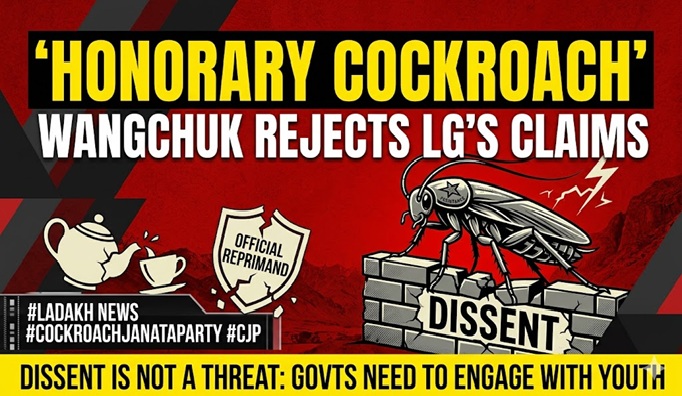
LEH, Ladakh – In a sharp rebuttal to the Lieutenant Governor of Ladakh, Vinai Kumar Saxena, noted educationist and climate activist Sonam Wangchuk has publicly rejected the LG’s recent characterization of their private meeting, declaring that he stands firm in his support for the “Cockroach Janata Party” (CJP).
The confrontation follows a meeting between the two figures earlier this week, which the LG’s office described as a cautionary session against “misleading narratives.”
A Tale of Two Meetings
While the LG’s official post on the social media platform X suggested that he had reprimanded Wangchuk for “fabricating provocative narratives” and warned him against further involvement with the CJP, Wangchuk has painted a drastically different picture.
“The Lieutenant Governor invited us for tea, and for nearly an hour, we engaged in a warm and cordial discussion regarding his initiatives, our work, and potential avenues for collaboration,” Wangchuk stated. He expressed shock upon seeing the LG’s subsequent post, describing it as an attempt to appease political observers in New Delhi rather than a reflection of their actual conversation. “There was absolutely no warning, reprimand, or confrontation of any kind during the conversation,” he added.
Stance on the ‘Cockroach Janata Party’
Central to the friction is the CJP, an online youth-led movement that utilizes the resilience of the cockroach as a symbol for democratic protest against issues such as systemic unemployment and government apathy.
During their discussion, the LG reportedly alleged that the movement was being funded or influenced by foreign entities, including the Soros Foundation and neighbouring countries like Pakistan and Bangladesh. Wangchuk, who has previously faced detention under the National Security Act, dismissed these claims as ironic.
“I was laughing inwardly at this narrative, because these very same things had been alleged against me when I was incarcerated,” Wangchuk said. He reaffirmed his commitment to the movement, declaring, “I am a huge admirer of the Cockroach Party, and I remain so today. I stand by my statement that I am an ‘Honorary Cockroach.'”
Clarifying the ‘Manipur’ Comparison
Addressing concerns that he had retracted his controversial comparison between the current political climate in Ladakh and the unrest in Manipur, Wangchuk provided a nuanced clarification.
He asserted that he never termed his comparison an “error of judgment,” as suggested by the LG. “I stand by that comparison even today,” Wangchuk explained. “All I said was that, given the prevailing circumstances, the use of that specific example could have been avoided. ‘Could have been avoided’ and ‘being an error of judgment’ are two entirely different things.”
Calls for Constructive Dialogue
Amid the standoff, both parties remain at odds regarding the role of dissent in a democracy. While the LG has cautioned that large-scale protests could harm Ladakh’s tourism and economic recovery, Wangchuk argues that the government should view these demonstrations as a symptom of genuine public grievance.
“Governments should not feel threatened by online dissent,” Wangchuk said, emphasizing that leaders should instead prioritize constructive engagement with the youth.
Despite the public spat, Wangchuk noted that parallel discussions between representatives from Ladakh and a sub-committee of the Ministry of Home Affairs have shown promise, contributing to an overall improvement in the region’s atmosphere.

As the situation evolves, the activist has called upon CJP founder Abhijit Dipke to continue transparently sharing data—pointing to analytics that suggest over 94 percent of the movement’s audience is domestic—to debunk allegations of foreign interference. For Wangchuk, the high level of Indian participation is evidence of “the Indian creativity inherent in democratic protest.”










Leave a Reply