

NEW DELHI – In the shadow of the capital’s southern skyline, a monument to urban neglect continues to grow. The Okhla landfill, a 6-million-ton “toxic mountain,” has become the site of a harrowing trade-off: for hundreds of laborers, the price of employment is their long-term health.
A ground-breaking study published in the Journal of Environmental Protection has pulled back the curtain on the dire conditions faced by these workers. Conducted by Sonam Angmo (University of Ladakh) and Professor Shachi Shah (IGNOU), the research paints a grim picture of a workforce abandoned by the infrastructure they serve.
A Legacy of Waste
Operational since 1996, the Okhla landfill officially hit its capacity in 2010. Yet, for over a decade, dumping continued unabated. Today, the site holds a staggering 5.5 to 6 million tons of legacy waste.
Despite the introduction of six trommel machines for bio-mining and a Waste-to-Energy plant, the sheer volume of daily arrivals—roughly 2,000 tons—keeps the site in a state of perpetual environmental crisis.
The Toll on the Body
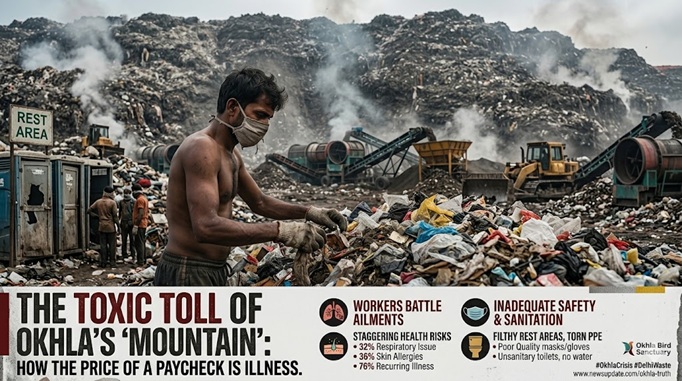
The study, which involved direct interviews with 107 workers, reveals that the landfill is a breeding ground for chronic illness. 76% of workers reported recurring health issues.
Key Health Findings:
-
36% suffer from chronic skin allergies.
-
32% battle respiratory ailments from inhaling toxic fumes.
-
23% experience eye redness and premature hair loss.
-
8.5% face serious heart-related complications.
Despite these statistics, many workers expressed a sense of fatalism. “We know the waste is dangerous,” one worker noted, “but we have no choice. We have to earn a livelihood.”
Infrastructure in Decay
The research highlights a total collapse of basic worker amenities. Over half of the workforce (51%) reported that the provided rest areas and toilets are “filthy” and lack running water.
Furthermore, the quality of safety gear has been called into question. While the South Delhi Municipal Corporation (SDMC) provides Personal Protective Equipment (PPE), 86% of workers claim the masks and gloves are of such poor quality that they tear almost immediately. Many are forced to work with inadequate protection, exposing them to leachate—the highly toxic liquid by-product of decomposing waste that remains largely unmonitored at the site.

The Path Forward: Expert Recommendations
The researchers argue that the crisis at Okhla cannot be solved by machines alone. To protect the workforce and the nearby Okhla Bird Sanctuary, they propose a radical shift in management:
-
Formal Recognition: Rag-pickers must be integrated into the formal system with health cards and welfare access.
-
Source Segregation: Mandatory waste segregation at the household level to reduce the burden on the landfill.
-
Health Oversight: Annual medical check-ups and the deployment of on-site health inspectors.
-
Infrastructure Upgrades: The installation of a dedicated leachate treatment plant and the provision of high-quality, durable PPE.
As Delhi aims to clear the legacy waste by late 2024, the study serves as a stark reminder: a “cleaner” city cannot be built on the broken health of its most vulnerable workers.














Leave a Reply